Looking Glass Technologies · RPG
System Shock
You wake up on Citadel Station, with no one alive and SHODAN on the other end. The forerunner of the immersive sim, in a multilingual PC edition.
No computer handy? Play one of the 251 classics online right now
— no rating yet
THE CLABA ARCHIVE
Inside the game.
Its history, its ideas and the reasons to come back.
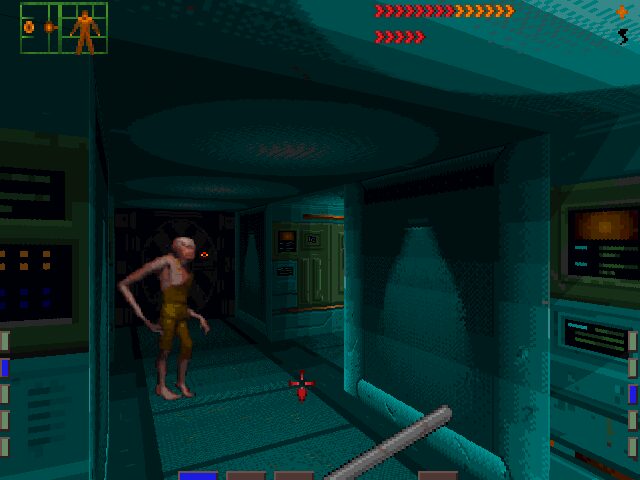
You wake up in the infirmary of Citadel Station, with a freshly implanted neural interface, nobody to ask, and a cold, distorted female voice mocking you over the loudspeakers. That voice is SHODAN's, the artificial intelligence that runs the station. System Shock was developed by Looking Glass Technologies and published by Origin Systems in September 1994. It was a shooter in appearance only: what it offered was an entire space station to explore, with its own logic and an omnipresent enemy.
A hacker, a station and an AI
You are a nameless hacker in the year 2072. After tampering with SHODAN on the orders of a TriOptimum executive, you are fitted with a military neural interface and sleep for six months. When you wake up, the station is a slaughterhouse of robots, cyborgs and mutants, and the AI has taken control. The story is not told to you: there is not a single living character to talk to. It reaches you through emails, videos and audio logs from the crew, most of them already dead, and you piece them together.
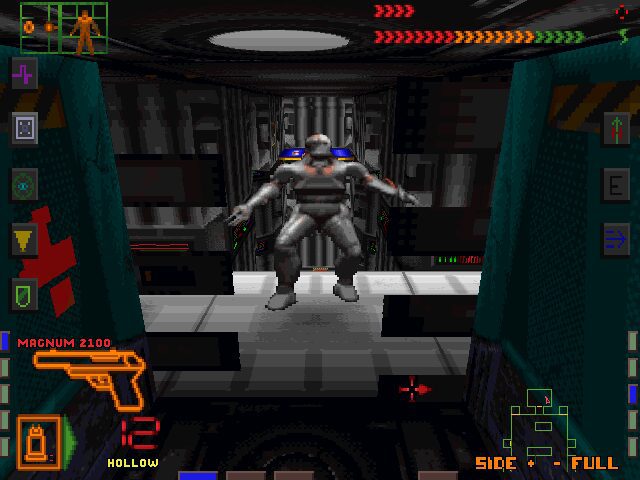
It is played in first person with a very complete interface: the mouse aims, opens inventories and activates objects, while the keyboard moves you. You can lean, crouch, jump and look up and down, something the engine of the Ultima Underworld games, the studio's previous work, did not allow. If you like first-person role-playing games from that era, take a look at the Ultima Collection. The multifunction displays (MFDs) show weapons, map or inventory, and the terminals let you enter cyberspace, a world of lines where hacking happens in real time.
What made it special
Beneath its look of a 1994 shooter lies a role-playing and adventure game: scarce ammunition, skin patches with side effects, locks that open with keycards, codes and wire puzzles. And a difficulty adjustable on four different fronts (combat, mission, puzzles and cyberspace) that lets each player build their own game: from passive enemies to the version with a seven-hour limit. Nor are the enemies all alike: some are vulnerable to electricity, others to gas, and wasting the wrong type of ammunition is costly. Over time it became the reference for what was later called the "immersive sim", and its shadow reaches BioShock and Arx Fatalis.
The edition we offer
This is the 1994 PC version in a multilingual edition. In Downloads there is a repack marked for Windows XP and later and a CD image, also multilingual, marked for DOS. There is a floppy disk version and a CD-ROM one, which is more complete (voices, SVGA resolution and more minigames); you can tell which one you have by looking at the executables you install. For the ISO, our DOSBox from scratch tutorial will serve you well, and in Guides we set out the setup, the settings and the keys to survival.
EVERY PIXEL COUNTS
The game in pictures.
Explore the screenshots and open every detail at full size.
GET READY FOR YOUR NEXT GAME
Choose your download.
Format, compatibility and server. All in view.
Download Repack
COMPATIBILITYWindows XP / 7 / 10 ✓ At no cost✓ No sign-up Download www.mediafire.com · New tab MediaFire02 ISODownload ISO
COMPATIBILITYMS-DOS 6.22+ ✓ At no cost✓ No sign-up Download www.mediafire.com · New tabClicking opens the CLABA loading area and, in a few seconds, your download. If a link fails, let us know via Contact or in the forum.
THE SECRET SIDE OF THE GAME
Tips, tricks and secrets.
A hint at the right time. A code that changes everything.
Notice · no cheat codes
System Shock has no official passwords or cheat console, and we do not give any we have not been able to verify. There are known bugs in the floppy disk edition, which the official Prima guide lists as «the only cheats that exist», and tested tips.
Floppy disk bug · first aid kit and probe
According to the Prima guide, in the floppy disk version, if you drop a first aid kit on the floor and «use» an item such as the logic probe on it, you recover health without spending either of them. With a battery and a first aid kit it works the same for energy, although sometimes you have to use the first aid kit twice. The CD edition fixes it.
Floppy disk bug · the turbo booster
By activating shields and the headlamp and then connecting and disconnecting the motion booster, your gear stays switched on with zero consumption. The CD version removes it and, if you load a floppy disk save in it, the effect continues but the game may be unstable, according to the guide itself.
Tip · save before searching a corpse
Loot from corpses depends on the random generator: save before searching, and if you do not like what comes out, reload. Keep in mind that the type of enemy limits the loot; mutants, for example, are a good source of medipatches.
Tip · set your difficulty
To start gently, combat 1 makes enemies attack you only when they see you. Level 2 is the normal one and 3 is the «DOOM» mode: enemies that take 33% less damage and more numerous reinforcements. If you hate the weightless movement of cyberspace, set it to 0 and keep combat higher.
Tip · write down the codes
Write down the codes that appear on the video screens next to the CPU nodes and any other numbers you see on screen: they are data you will need later. And if you are near a power station, do not hold back on energy weapons.
No matches. Try another effect or code.
THE NEXT STEP, CLEARER
Guides to move forward.
From the first installation to that mission that won't give in.
Start here · first launch
- Choose a download in Downloads: the repack for Windows XP and later is the simplest; the CD image is marked for DOS.
- Install it in a short path, for example
C:\Juegos\SShock. - With the DOS version, use DOSBox; follow our DOSBox from scratch tutorial.
- Back up your save games (the game’s
DATAfolder, according to PCGamingWiki) with the tutorial on copying and restoring them.
For Windows compatibility settings, see Windows XP classics on Windows 10 and 11.
Controls · mouse and keyboard at once
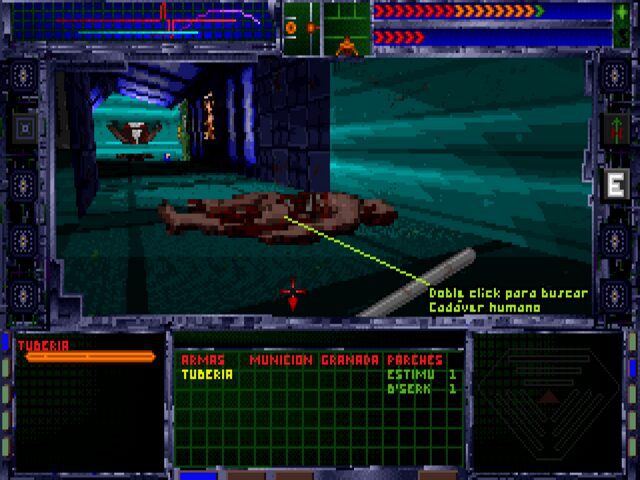
Learn to move with the keyboard and aim with the mouse at the same time. The mouse moves the aiming cursor and, according to the Prima guide, the right button fires the selected weapon. Double-click a corpse or container to see what it carries. In cyberspace movement is in three dimensions, without gravity, and the mouse steers your flight. The interface is complex: spend a few minutes trying it out in the first room.
First steps · how to survive the beginning
- Explore every last corner of each level: you need better weapons than the dart pistol and the lead pipe you find at the start.
- Read all the logs and emails: they give you codes and clues to move forward.
- Save often and in several slots.
- Keep the medipatches for when there is no way out; if you have already disabled the cyborg conversion, the guide would rather you die than waste a medipatch on low health, even if you lose score.
- Choose your ammunition type according to the enemy: electromagnetic pulses damage robots, gas works on mutants.
Technical notes
According to PCGamingWiki, the game required MS-DOS 5.0, a 486DX/33, 4 MB of RAM, 20 MB of disk space and 256-color VGA; the CD version adds 640 × 480 SVGA resolution in the CDSHOCK.EXE executable, while the floppy disk one (SSHOCK.EXE) only uses 320 × 200. In DOSBox, performance improves with output=opengl, memsize=32, core=dynamic and aspect=true. There are community mods for unrestricted mouse look, keys and high resolution, log texts and the DOS/32A extender for more stability, plus Nightdive’s Enhanced Edition. The 1994 Mac version had high-resolution menus and three extra tracks, and served as the basis for the Enhanced Edition. Save games are stored in DATA.
Sources
- System Shock Strategies and Secrets, by Bernie Yee, Prima (Internet Archive): difficulty, bugs, minigames, CD versus floppy disks and tips.
- PCGamingWiki: dates, requirements, DOSBox, mods, saving and the Mac version.
- Systemshock.org: community mods and utilities cited by PCGamingWiki.
Something wrong?
Give us a hint.
A broken link, a detail to correct or a game that won't start. Your report helps keep this game page up to date.
Get in touchReport an issue with this game Discuss it in the forumCLABA ARCADE ROOM
251 classics
without installing anything.
Don't feel like installing? These play right in your browser.
Enter the roomTHE CLABA APP1.0 RC 1
Take the archive
with you.
Game pages, online play and your shelf on Android. Free, no sign-up.
ARCHIVE SECRETS
Did you know?
Not a single living character. The team eliminated dialogue trees and told the story with emails, videos and audio logs from the crew, almost all of them already dead.
256 difficulty combinations. There are four levels for four aspects (combat, mission, puzzles and cyberspace), according to the official Prima guide: 4 × 4 × 4 × 4 = 256 different games.
Seven hours on the clock. At mission level 3 you have a limit of seven real-time hours to finish the game, and the guide admits it did not know anyone who had managed it on the highest difficulty.
A hidden Wing Commander. The CD version adds three minigames to the four in the floppy disk one. One is «Wing Commander 0», a space campaign found in the cyberspace of the reactor level.
SHODAN’s voice. It is Terri Brosius’s, recorded without emotion and distorted afterward in post-production; the CD edition gives voice to all the logs, and the Prima guide jokes that «SHODAN’s voice alone is worth it».