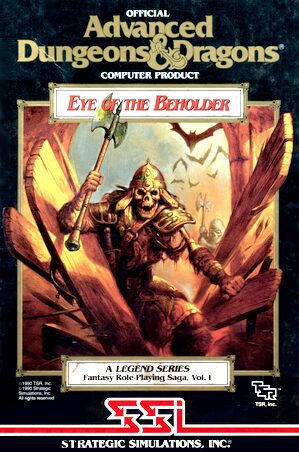
Strategic Simulations Inc. · RPG
Eye of the Beholder II: The Legend of Darkmoon
Westwood and SSI's sequel: an evil temple, catacombs and three towers in a real-time dungeon crawler with a party you can import from the first game.
Role-playing game by Strategic Simulations Inc. (1991) for PC (in Spanish) and Amiga.
Choose your version 2 platforms
No computer handy? Play one of the 251 classics online right now
— no rating yet
THE CLABA ARCHIVE
Inside the game.
Its history, its ideas and the reasons to come back.
A warning from Khelben «Blackstaff» Arunsun, archmage of Waterdeep, interrupts the rest of the heroes of Eye of the Beholder: he has sent a scout to investigate a temple called Darkmoon, and she has not returned. Eye of the Beholder II: The Legend of Darkmoon is the second installment of the role-playing trilogy that Westwood Associates made for SSI, released in 1991 under license from Advanced Dungeons & Dragons.
A temple, catacombs and three towers
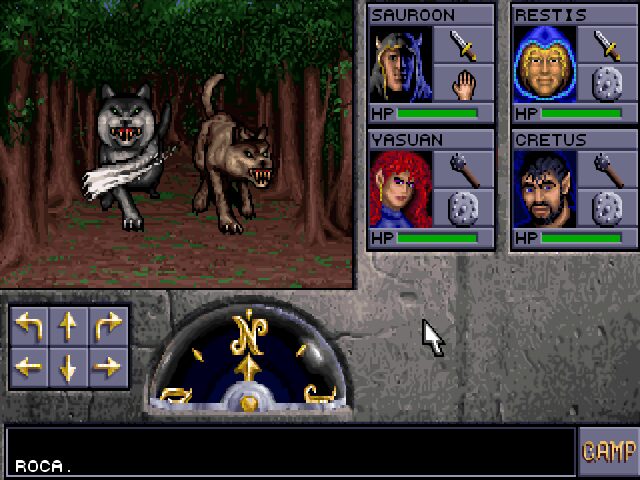
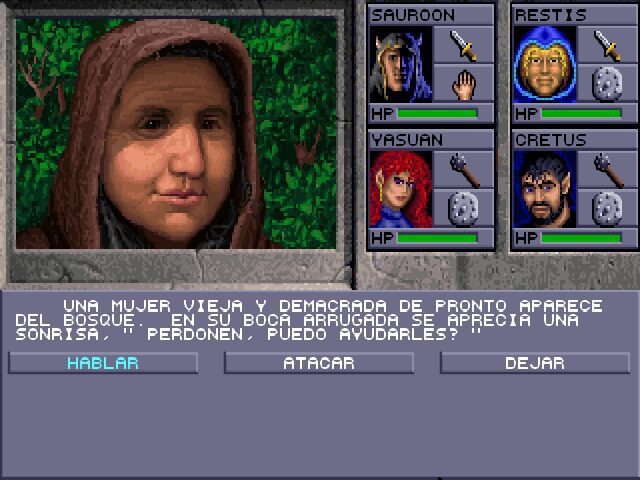
Khelben teleports the party to the vicinity of the temple and the adventure moves out into the open air, with new outdoor areas such as the opening forest. After that you have to fight your way through the temple itself, the lower catacombs and the three towers, silver, blue and crimson, that crown it. Along the way you stumble upon giant ants, basilisks, spirits of the dead and, of course, the odd beholder. The high priest, Dran Draggore, is preparing legions of skeletons to attack Waterdeep, and the ending, which surprised players with its originality, holds one last surprise: the priest turns out to be a red dragon.
How it plays
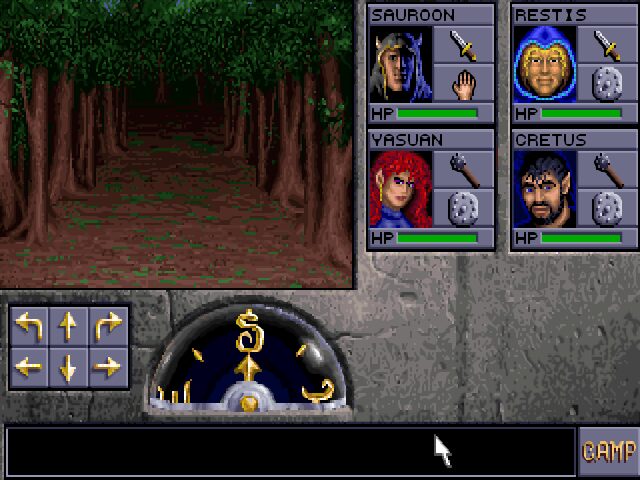
It is a real-time, first-person dungeon crawler with a split screen: a viewing window, portraits of the characters showing what they hold in their hands, a compass and arrows for moving around. You control four adventurers, plus one or two non-player characters who join you along the way, and everything is done with the mouse: click on an object in the scene to pick it up, throw it or operate it; on a character’s weapon to attack; on their face to see the inventory and stats. You can walk faster with the keyboard. You can create the party from scratch (the review of the Amiga version praises being able to tweak the attributes without repeating hundreds of rolls) or import the party from the first game.
The formula comes from Dungeon Master and the critics of the time compared it to that game, but Westwood added outdoor areas, more role-playing, more interaction with the environment and more story scenes, with choices included. The puzzles are simple, but they require you to look at everything: hidden buttons, secret doors, and objects tucked away in every corner.
Reception
SSI sold 73,109 copies of the game, and the whole series surpassed 350,000 by 1996. Dragon gave it five stars out of five in 1992, and Computer Gaming World ranked it among the best role-playing games of that year, although Scorpia criticized the interface, which forced you to rummage through the spellbook while monsters attacked. GameSpy would later recall its «almost insane level of difficulty.»
The edition we offer
Under Downloads there is a Spanish-language repack ready to install and play on Windows XP, 7 and 10. The original was an MS-DOS game: if needed, the DOSBox tutorial explains how classics from that era are run, and the one on Windows XP games on current computers answers the rest of your questions. If you want the complete trilogy, we have Eye of the Beholder Trilogy and the end of the series in Assault on Myth Drannor; for another Westwood dungeon crawler, Lands of Lore. The controls and technical notes are under Guides, and a few tips for staying alive are under Tips & tricks.
ONE GAME, 2 PLATFORMS
Versions.
2 platforms1991–1992
Pick a platform: the screenshots, downloads and online game on this page switch with it.
- Year
- 1991
- Port by
- Westwood Associates
- Downloads
- 1
- Screenshots
- 3
The original MS-DOS version, published by Strategic Simulations in 1991 and developed by Westwood Associates. It supports EGA, MCGA and VGA displays, and it is the one with Frank Klepacki's music for the AdLib chip. The edition on this game page is a Spanish-language repack.
- Year
- 1992
- Downloads
- 1
- Screenshots
- —
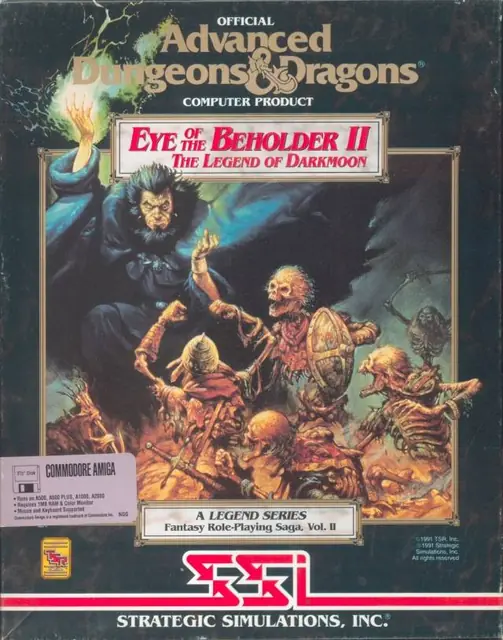
Amiga version of the same game, published by SSI after the PC one (the exact date varies by source: 1992 according to Wikipedia). A 1994 review in Amiga Online Review describes it as played almost entirely with the mouse, requiring 1 MB of RAM and 3.5 MB of space available if installed on a hard disk, and the manual word-lookup copy protection appearing only once. The One gave it 87%.
EVERY PIXEL COUNTS
The game in pictures.
Explore the screenshots and open every detail at full size.
GET READY FOR YOUR NEXT GAME
Choose your download.
Format, compatibility and server. All in view.
Version
SELECTED VERSIONPC1991 · 1 file
Clicking opens the CLABA loading area and, in a few seconds, your download. If a link fails, let us know via Contact or in the forum.
HIT PLAY
The game in motion.
Trailers and videos to see it in action.
-
Amiga · Gameplay
Gameplay of Eye of the Beholder II: The Legend of Darkmoon on the Amiga.
THE SECRET SIDE OF THE GAME
Tips, tricks and secrets.
A hint at the right time. A code that changes everything.
Tip · there are no reliable codes
We have not found reliable, verified cheat codes for the PC version, so here you only get tried-and-tested tips. If you come across lists of «codes» for other versions, ignore them: none of them could be verified.
Tip · import your party
If you have already finished the first game, copy its EOBDATA.SAV into this game’s folder and choose «Transfer EoB 1 Party» from the main menu; you will pick which characters to bring over. It is the most convenient way to start with a seasoned party.
Tip · build your party well
According to the review of the Amiga version, you can tweak the attributes of new characters without repeating rolls, so balance a party with fighters in front, a cleric for healing and a mage for offensive support.
Tip · search every corner
The puzzles are solved with buttons, secret doors and hidden objects. Click on suspicious walls, read every little plaque and don’t leave any item behind: a review from the time warns that some, such as the six polished shields that open one of the towers, are easy to overlook.
Tip · use the keyboard to move
The mouse does everything, but according to the reviews the keyboard is faster for walking and turning. Combine them: keyboard to move, mouse to fight and manage the inventory.
No matches. Try another effect or code.
THE NEXT STEP, CLEARER
Guides to move forward.
From the first installation to that mission that won't give in.
Start here · first launch
- Download the Spanish-language repack from Downloads and unzip it into a short path, such as
C:\Juegos\EOB2. - Run the game’s shortcut. If something fails on your Windows, see the tutorial on Windows XP classics on Windows 10 and 11.
- From the main menu you can create a new party or import the one from the first game.
- Save often and copy the
EOBDATA*.SAVfiles once you have a good party: the tutorial on save game backups explains how.
Controls · mouse and keyboard
- Mouse: almost everything. Click on the arrows below the view to move, on objects in the scene to pick them up or operate them, on a character’s hands to attack or cast a spell, and on their face to open their inventory.
- The inventory is handled by clicking the item and then its destination.
- Keyboard: useful for walking and turning more quickly.
First steps · how to survive in Darkmoon
- Form a party with sturdy front-liners, a healer and a mage; you can also import the one from the first game.
- The game is real-time but has no time limit: you can stop and think.
- Draw the map by hand: according to the review of the Amiga version, the game has no automap.
- Examine your surroundings: levers, buttons and little plaques move the story forward.
- When your party is wounded, retreat and recover before going on: combat is real-time.
Technical notes
The original requirements were modest: a 286, 640 KB of memory and an EGA, MCGA or VGA card. The configuration and saves are stored together in EOBDATA*.SAV. According to PCGamingWiki, the current commercial edition (GOG and Steam, in the Forgotten Realms collection) comes with DOSBox, and there is a Windows program, The All-Seeing Eye, that adds an automap and backups when playing in DOSBox. If your repack runs with DOSBox, see the DOSBox from scratch tutorial.
Sources
- PCGamingWiki · Eye of the Beholder II: party import, save files, copy protection, requirements and The All-Seeing Eye.
- Review of the Amiga version (Amiga Online Review, February 1994): interface, character creation, puzzles and comparisons.
- Steam · Forgotten Realms collection: digital edition with DOSBox alongside Eye of the Beholder I and III.
- Wikipedia · Eye of the Beholder II: plot, music, sales and reception (Dragon, Computer Gaming World, GameSpy, The One).
Something wrong?
Give us a hint.
A broken link, a detail to correct or a game that won't start. Your report helps keep this game page up to date.
Get in touchReport an issue with this game Discuss it in the forumCLABA ARCADE ROOM
251 classics
without installing anything.
Don't feel like installing? These play right in your browser.
Enter the roomTHE CLABA APP1.0 RC 1
Take the archive
with you.
Game pages, online play and your shelf on Android. Free, no sign-up.
ARCHIVE SECRETS
Did you know?
Klepacki’s first soundtrack. The music is by Frank Klepacki, who composed with AdLib’s Visual Composer for the YM3812 chip; it was one of his first jobs at Westwood. Paul Mudra, who wrote the music for the first game, only did sound effects.
A tailor-made ending. GameSpy noted that Darkmoon had a completely original ending, something the first game had lacked. The high priest Dran Draggore is revealed to be a red dragon.
Your party, from one game to the next. You can import the party from the first Eye of the Beholder: PCGamingWiki says you just have to copy its save file (EOBDATA.SAV) and choose «Transfer EoB 1 Party» from the main menu.
Six polished shields. A review of the Amiga version warns that you have to gather six polished shields before entering one of the towers, and that they are hard to find if you haven’t searched every corner.
87% on the Amiga. The One magazine scored the Amiga version at 87%, and praised the look of the graphics and the animation.