LucasArts · Strategy
Afterlife
Build Heaven and Hell at the same time, reward virtues, punish sins and keep the Surfers of the Apocalypse away. LucasArts, 1996.
No computer handy? Play one of the 251 classics online right now
— no rating yet
THE CLABA ARCHIVE
Inside the game.
Its history, its ideas and the reasons to come back.
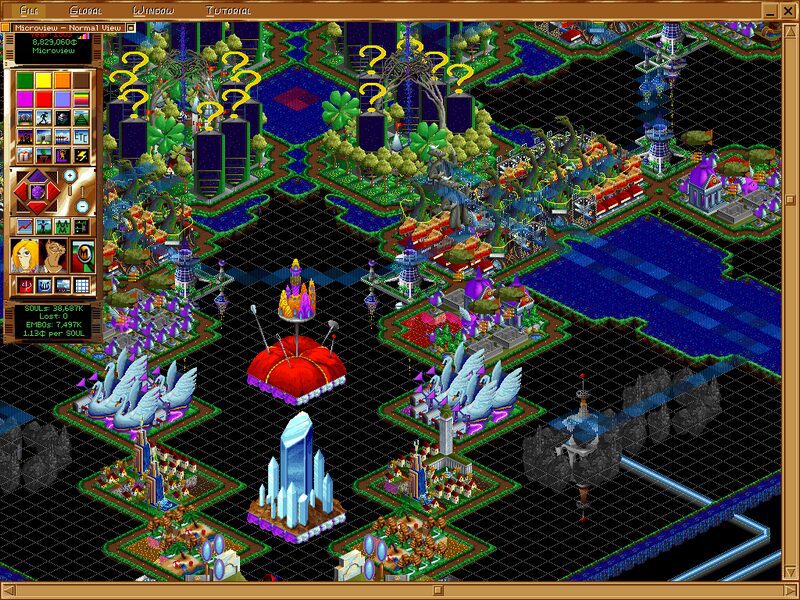
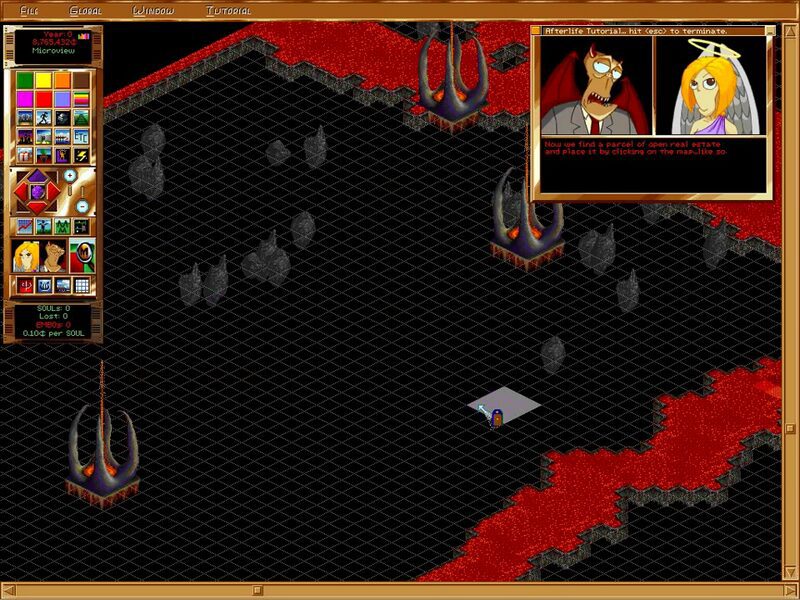
What happens to souls when they die? It depends on how well you have laid out the roads of Hell. Afterlife is the building simulator with which LucasArts dared to take the SimCity formula to the hereafter, and it did so with the sense of humor we already knew from its graphic adventures.
Celestial (and infernal) urban planning
You are a Demiurge, an almost omnipotent being to whom the Powers That Be assign a very specific task: to build and run both the Heaven and the Hell of a planet. Its inhabitants, the EMBOs, live, sin or behave themselves and, when they die, their souls arrive in your afterlife awaiting what they have earned.
Afterlife came out in June 1996 simultaneously for MS-DOS, Windows and Mac, something unusual for LucasArts, which usually launched on PC first. It was designed by Michael Stemmle, who drew inspiration from his games of SimCity and his interest in Dante’s Inferno, and the music is by Peter McConnell.
How it plays
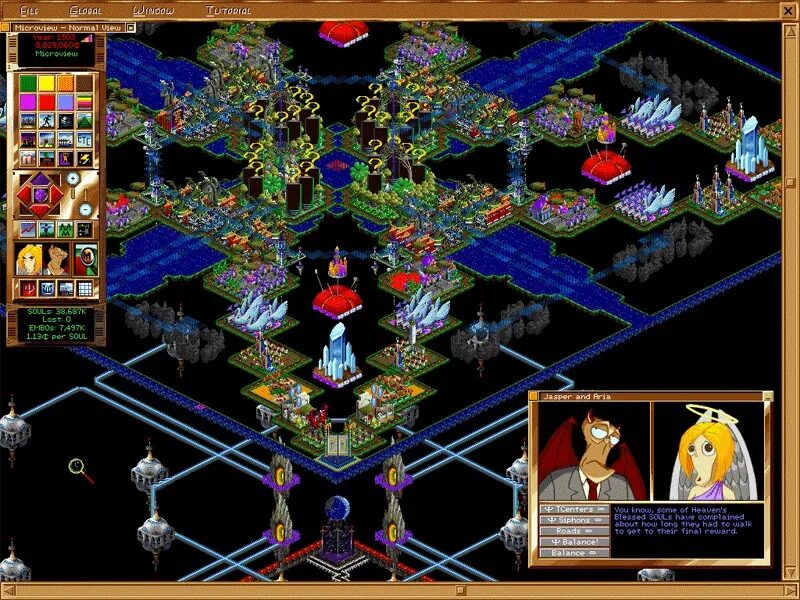
As in any city simulator, you divide the land into zones, lay out roads and wait for the inhabitants to arrive. The difference is what you build: in Hell, zones for each of the seven deadly sins (envy, greed, gluttony, sloth, pride, wrath and lust); in Heaven, for their opposing virtues. Each soul needs the punishment or reward that fits what it did in life, and if it does not find it, it is lost.
Besides the zones you have service buildings, roads, entry gates and special structures, and everything runs on heavenly money that can run out. Meanwhile, the planet evolves and its technology advances, which makes the population grow and changes how many souls come to you. You are advised by Aria Goodhalo, an angel, and Jasper Wormsworth, a demon, who warn you of problems with a lot more wit than any city councilor.
What made it special
Afterlife is a game of systems, with dozens of graphs and maps, but above all it is a satire. There are more than 200 illustrated rewards and punishments, almost 300 different tiles and buildings, and a collection of «Bad Things», random disasters that can wipe out entire neighborhoods if you do not have the special buildings that keep them at bay. If you stay in debt too long, the Surfers of the Apocalypse show up; if there are too many unemployed souls, Heaven and Hell end up at war. And if you abuse the cheats, the game punishes you with a Death Star that destroys your buildings.
It did not sell enough to turn a profit, according to its designer, but Macworld chose it as the best simulation game of 1996.
The version on this page
Afterlife was published in Spain with the text in Spanish and the voices in English. Here you have two downloads: a Spanish repack for Windows (XP, 7 and 10, according to the label) and the ISO image of the Spanish CD, which the game page marks for Windows and MS-DOS. According to PCGamingWiki, the Windows version has problems on current systems and the MS-DOS one runs very well in DOSBox. We explain it in Guides, and in Tips & tricks you have advice so your souls do not end up wandering.
More simulators and more LucasArts
If you are left wanting more urban planning, the archive has Sim City 2000 and Theme Hospital. And if it is LucasArts humor you are after, try Grim Fandango, which also has a lot to say about the hereafter. For questions or Hell designs worth showing off, there is the Afterlife thread on the forum (in Spanish).
EVERY PIXEL COUNTS
The game in pictures.
Explore the screenshots and open every detail at full size.
GET READY FOR YOUR NEXT GAME
Choose your download.
Format, compatibility and server. All in view.
Download Repack
COMPATIBILITYWindows XP / 7 / 10 ✓ At no cost✓ No sign-up Download www.mediafire.com · New tab MediaFire02 ISODownload ISO
COMPATIBILITYMS-DOS 6.22+ ✓ At no cost✓ No sign-up Download www.mediafire.com · New tabClicking opens the CLABA loading area and, in a few seconds, your download. If a link fails, let us know via Contact or in the forum.
THE SECRET SIDE OF THE GAME
Tips, tricks and secrets.
A hint at the right time. A code that changes everything.
Tip · Balance sins and virtues
Do not build only the punishments or rewards you like best. Each soul needs the one that corresponds to its sin or virtue; if it does not find it, it is lost. Spread out the zones for the seven sins and the seven virtues according to what the arrival graphs tell you.
Tip · Watch your debt
Long-term debt brings the Surfers of the Apocalypse, which is the most spectacular way to lose the game. Check your finances often and do not go into debt to grow faster than you earn.
Tip · Give the souls work
Too many unemployed souls end up causing a war between Heaven and Hell. Before expanding the zones, make sure there are jobs for those who arrive.
Tip · Protect yourself from Bad Things
Random disasters can be kept at bay with the right special buildings. If you turn them off to save money, the arrival of souls is cut in half, so decide carefully.
Warning · Cheats come at a price
Afterlife punishes those who abuse cheats: if you go too far, a Death Star appears and destroys your buildings. If you want to play fair, the challenge is enough.
No matches. Try another effect or code.
THE NEXT STEP, CLEARER
Guides to move forward.
From the first installation to that mission that won't give in.
Start here · first launch on a current PC
- In the Downloads tab, choose the Spanish repack; MediaFire opens in a new tab.
- Unzip it into its own folder with write permission: save games are stored in the
SAVEsubfolder. - Run the included launcher and check that the text appears in Spanish.
If you prefer the ISO, use the MS-DOS version in DOSBox: install it from the mounted CD and keep the image mounted while you play, or copy the contents of the CD to a folder and change the CD Path line in the AFTERDOS.INI file to point to it. Our guide DOSBox from scratch (in Spanish) explains how to mount folders and images.
Controls and first steps
Everything is played with the mouse: you pick tools from the top bar, lay out zones and roads by dragging, and check maps and graphs in the menus. F9 opens the sound options.
- Start with the gates of Heaven and Hell; without them nobody comes in.
- Lay roads from the gates.
- Zone a few plots for each sin and each virtue.
- Watch which souls arrive and expand according to demand.
- Listen to Aria and Jasper: when something goes wrong, they tell you.
Strategy · an afterlife that works
- Grow little by little. Expanding without money ends in debt, and debt ends in Surfers.
- Jobs and souls at once. Zones need workers, and workers need room. If there are too many unemployed souls, slow down before a war breaks out.
- Look at the graphs. Afterlife has many: use them to see which sins and virtues dominate on the planet and adapt your zones.
- Be patient with the planet. Its technology advances and that changes how many souls come to you; what worked at the start may become too small.
Share your designs or ask for help in the forum thread (in Spanish).
Technical notes
- Language: the Spanish version translates the text and subtitles; the voices stay in English.
- Windows version: PCGamingWiki indicates that it has problems on current systems; on 64-bit Windows 7 the tutorial may stay blank, which is fixed with Windows 95 compatibility mode.
- MS-DOS version: it runs very well in DOSBox. It requires 256-color SVGA and hangs above 1024 × 768, so do not raise the resolution any further in
AFTERDOS.INI. - Music: it uses iMUSE, the LucasArts system that adapts the music to what is happening and to what you are looking at.
Sources
- PCGamingWiki · Afterlife: dates, languages, DOS and Windows versions, configuration, save games, resolution and iMUSE.
- Afterlife on Steam: official description, content and requirements of the re-release.
- Wikipedia (English): design, EMBOs, sins and virtues, advisors, disasters, losing conditions, voice actors and reception.
Something wrong?
Give us a hint.
A broken link, a detail to correct or a game that won't start. Your report helps keep this game page up to date.
Get in touchReport an issue with this game Discuss it in the forumCLABA ARCADE ROOM
251 classics
without installing anything.
Don't feel like installing? These play right in your browser.
Enter the roomTHE CLABA APP1.0 RC 1
Take the archive
with you.
Game pages, online play and your shelf on Android. Free, no sign-up.
ARCHIVE SECRETS
Did you know?
SimCity plus Dante. Michael Stemmle, its designer, said the idea came from his games of SimCity and his interest in Dante’s Inferno.
A marching band name. The planet’s inhabitants are called EMBOs, «Ethically Mature Biological Organisms». It is a nod from Stemmle to the «Executive Marching Band Officers» of the Stanford University band, which he was part of.
Only four voices. The whole game was voiced by four actors: Rebecca James, Milton James, Steve Blum and Carrie Gordon.
Heaven and Hell on Mac the same day. Unlike earlier LucasArts games, Afterlife came out on PC and Macintosh at the same time. Macworld named it the best simulation game of 1996.
«The most sophisticated engine of any simulator that starts with A». That is how its official description still advertises it, along with more than 200 illustrated rewards and punishments.