Apogee Software · Shooter
Duke Nukem
Duke's 1991 debut: EGA platforming, a nuclear pistol and three episodes against Dr. Proton and his Techbots. Windows repack and DOS original, in English.
No computer handy? Play one of the 251 classics online right now
4.8 12 votes
THE CLABA ARCHIVE
Inside the game.
Its history, its ideas and the reasons to come back.
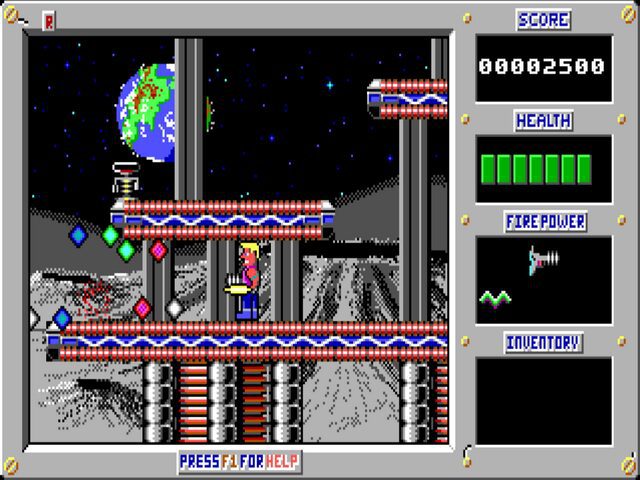
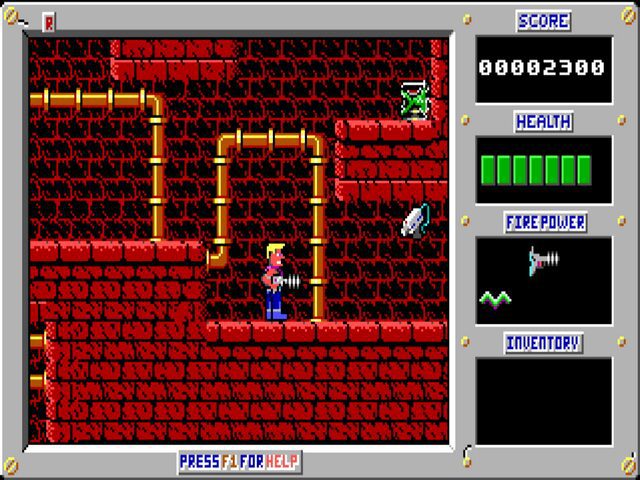
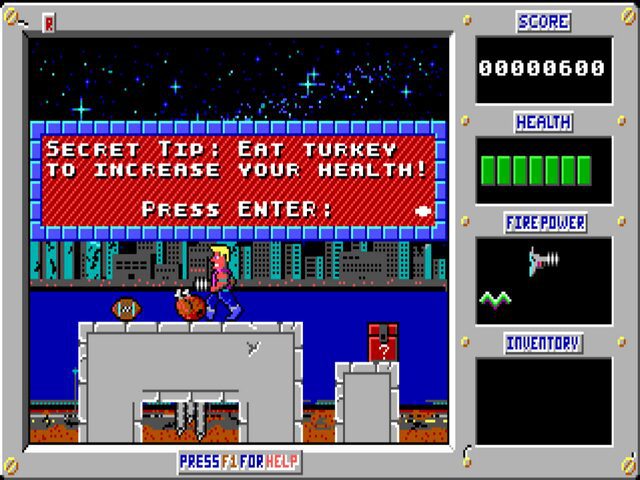
Before the sunglasses, the one-liners and the pig cops, Duke Nukem was a blond guy who jumped between platforms with a gun in his hand and the beeps of the PC speaker as his only soundtrack. Apogee Software published it on July 1, 1991 for MS-DOS, with EGA graphics and the company’s shareware model: the first episode circulated at no cost and the other two were bought from Apogee.
A mad scientist and his army of Techbots
The story fits on a napkin, and that is how Apogee wanted it. In the near future of 1997, Dr. Proton, a nuclear physicist who lost his mind after a radiation accident, builds an army of robots, the Techbots, in his underground fortress and seizes a major American city. The CIA hires Duke, who according to the original booklet would rather stay in his Los Angeles apartment watching soap operas, to take him down. There are three episodes: Shrapnel City, in the devastated city; Mission: Moonbase, in Proton’s lunar base; and Trapped in the Future!, in the future to which the villain flees.
How to play
It is a platform shooter with scrolling in all four directions. Duke runs, jumps and fires his nuclear pistol only forward; the upgrades he picks up let him have more shots on screen at once. Almost everything can be blown up: robots, crates, fake walls and even food. Red crates hold food to restore health, blue ones score prizes and gray ones useful items, such as keys, boots to jump higher or grappling hooks to hang from the ceiling, although sometimes they hide a bomb.
There are no lives: if Duke falls, he repeats the level from the start. You can only save in the blue corridors that separate each stage, with nine positions. And at the end of each level the game hands out seven secret bonuses of 10,000 points, for feats such as destroying all the cameras or collecting the letters D, U, K and E in order.
The origin of a legend
It was programmed by Todd Replogle, with graphics by Jim Norwood, Allen H. Blum III and George Broussard, and Scott Miller, Apogee’s founder, as producer. Miller designed all the levels of the shareware episode and handled the sound effects himself. The game was going to be called Heavy Metal, but Miller did not like it at all: he proposed naming it after the protagonist, as in comics, and between the two of them they christened it. According to Miller, it sold between 60,000 and 70,000 copies, and he himself lists it among the three great hits of that Apogee, alongside Commander Keen and Wolfenstein 3D. Its direct successor, Duke Nukem II, arrived in 1993, and the leap to three dimensions with Duke Nukem 3D turned the character into an icon.
The edition we offer
Under Downloads there are two options, both in English: a repack to install and play on Windows XP, 7 or 10, and the original for MS-DOS, to set up your own way in DOSBox with the help of our tutorial DOSBox from scratch (in Spanish). If on launch you read “Duke Nukum,” you have not got the wrong game: that was the name of version 2.0, as we tell you under Did you know?
Under Guides you have the controls, how saving works and a strategy so you do not get stuck; under Tips & tricks, Apogee’s official code and the debug mode. If you are left wanting more of the company’s platformers, try Bio Menace or Hocus Pocus; for first-person shooters, Apogee also published Rise of the Triad.
EVERY PIXEL COUNTS
The game in pictures.
Explore the screenshots and open every detail at full size.
GET READY FOR YOUR NEXT GAME
Choose your download.
Format, compatibility and server. All in view.
Download Repack
COMPATIBILITYWindows XP / 7 / 10 ✓ At no cost✓ No sign-up Download www.mediafire.com · New tab MediaFire02 OriginalDownload Original
COMPATIBILITYMS-DOS 6.22+ ✓ At no cost✓ No sign-up Download www.mediafire.com · New tabClicking opens the CLABA loading area and, in a few seconds, your download. If a link fails, let us know via Contact or in the forum.
THE HOUSE VIEW
CLABA review.
What shines, what weighs it down and our verdict.
CLABA'S VERDICT
The KING has arrived!
The original Duke Nukem game, released in 1991, was a great success in its day and laid the foundations for the successful franchise that would follow. Although today it may seem a simple, basic game, at the time it was innovative and entertaining.
The classic under the magnifying glass
ESCALA 0—100Banda Sonora
95/100Graphics
80/100Jugabilidad
85/100History
72/100What shines
03 CLAVES- It has a great variety of enemies and levels, which makes it very entertaining and challenging.
- The game's soundtrack, composed by Bobby Prince, was very popular in its day and is considered one of the best of 1990s PC games
- It was one of the first games to feature a main character with a unique and distinctive personality, which became one of the most recognizable icons in video games.
What falls short
03 CLAVES- The lack of variety in enemies and settings can make the game feel monotonous after a while.
- The game has no deep story or plot, which can make players lose interest after a while.
- The game's difficulty can be high for some players, which can be frustrating and even discouraging.
THE SECRET SIDE OF THE GAME
Tips, tricks and secrets.
A hint at the right time. A code that changes everything.
How to enter them
Duke Nukem’s codes are not typed: you press several keys at the same time during the game. The official code always works; the debug mode ones only if you launch the episode’s executable with the parameter asp, in lowercase.
Keys and gun at maximum
Press Backspace and PgDn at the same time (Retroceso and Av Pág on a Spanish keyboard): you get the four colored keys and the nuclear pistol at full power. It is the cheat that Apogee’s own booklet recommended as a last resort, and it works in both the shareware and the registered version.
Debug mode
With the game launched with asp (for example, DN1 asp for the first episode), press G + O + D at the same time to recover all your health and get all the items, or G + O + W to jump to the next level. It is not a level select: you have to repeat it to advance one level at a time.
Tip · the seven secret bonuses
Each is worth 10,000 points at the end of the level: destroy all the cameras, take no hits, bring down all the ACME signs, destroy all the missiles, collect D, U, K and E in order (which also gives 10,000 points on the spot), take out the snake robot with blue and white balls and eliminate all the Techbot rabbits.
Tip · crates and bombs
Red crates have food; blue ones, score prizes; and gray ones, important items, bombs or nothing. If a bomb explodes nearby and you have room above, jump into the center of the explosion and it will not hurt you.
Tip · enemies with a trick
The small flying robots with a blade underneath can be destroyed by jumping on them, without losing health. The fire wheel is only vulnerable when its flames go out. And if you shoot a soda can and catch it as it falls, it is worth 1,000 points instead of 200.
Tip · the first secret room
On the first level of the first episode there is a secret room in the basement. Go to the right of the ledge with the two blue floppy disks, next to the ceiling spikes, shoot the wall that breaks and drop into the void to collect the hidden prizes.
No matches. Try another effect or code.
THE NEXT STEP, CLEARER
Guides to move forward.
From the first installation to that mission that won't give in.
Start here · which download to choose
Under Downloads you have two options, both in English.
- Repack: the simple route. It is set up to install and play on Windows XP, 7 or 10. Install it in a short path, such as
C:\Juegos\DukeNukem, and launch it from its shortcut. - Original for MS-DOS: to set up your own way. On a current PC it needs DOSBox; our tutorial DOSBox from scratch (in Spanish) explains it step by step, and if you want to carry it on a USB stick, see how to create a portable game with DOSBox (in Spanish).
Each episode has its own executable: DN1, DN2 and DN3. With DOSBox the default configuration, with cycles=auto, is enough. Before switching versions, back up your save games by following this tutorial (in Spanish).
Controls
- Left and right arrow keys: move.
- Ctrl: jump.
- Alt: fire the nuclear pistol.
- Up arrow key: action key. It activates elevators and teleporters, reads notes and monitors, opens doors and inserts cards and keys. With the grappling hooks, it also lifts Duke onto the ledge above if there is room.
- F1: options menu, also for saving in the corridors between levels.
The keys can be changed from within the game and it also supports a joystick. It does not use the mouse.
First steps · how to survive Proton
- Save in every blue corridor. It is the only place where you can: press F1, then S, and choose a position from 1 to 9. Save games can only be loaded from the title screen or from those corridors.
- Dying is cheap, but not costless. Lives are unlimited, although each death sends you back to the start of the level.
- Eat everything you find. Food and sodas restore health; they are often inside the red crates.
- Look for the pistol upgrades. Each one adds a simultaneous shot on screen, up to a maximum of five.
- Destroy the reactors. They power the Techbots and Proton’s traps, and give 20,000 points.
- Explore. There are several routes per level and many walls that break with a single shot.
Technical notes
Graphics and sound. It runs in EGA at 320 × 200, also on VGA cards. It does not support sound cards: everything plays through the PC speaker, and the S key turns it on or off. The game runs at about 16 frames per second and scrolls the screen in 8-pixel blocks, so choppy movement is normal.
Requirements of the day. An XT PC (better a 286), 520 KB of conventional memory and 3.6 MB of disk space for the registered version.
Files. Save games are stored as SAVED*.DN* and the keyboard configuration as KEYS.DN* in the game folder; the last number indicates the episode.
Duke Nukum. Version 2.0 changed the protagonist’s name in screens and texts. The game is the same. The fan project ReDuke, a reimplementation for Windows, can restore the original name.
Sources
- 3D Realms · official Duke Nukem I page (archived): release date, authors, requirements, speaker sound and the story of “Duke Nukum.”
- Apogee booklet “Story, Hints and Cheat Mode!” (Internet Archive): plot, saving, scores, secret bonuses, hints and the Backspace + PgDn code.
- Duke Nukem Repository · in-game help: controls, rules for lives and credits according to the internal help.
- RGB Classic Games · Duke Nukem: official code, debug mode with
aspand shareware versions 1.0 and 2.0. - Duke Nukem Wiki · Duke Nukem I: episodes, weapon, block scrolling and codes.
- Apogee · Duke Nukem, little known facts (Scott Miller): “Heavy Metal,” the name, Duke Nukum, Duke University and Broussard’s smile.
- Game Developer · interview with Scott Miller: sales, level design of the shareware episode and sound effects.
- Strife Streams · interview with Todd Replogle (2001): John Carmack’s help.
- PCGamingWiki · Duke Nukem: one executable per episode, DOSBox, save and configuration files, 16 fps and resolution.
- ModdingWiki · Duke Nukem: file formats, nine save positions and
DN?.EXEexecutables. - Forum thread (in Spanish): content and language of the downloads.
Something wrong?
Give us a hint.
A broken link, a detail to correct or a game that won't start. Your report helps keep this game page up to date.
Get in touchReport an issue with this game Discuss it in the forumCLABA ARCADE ROOM
251 classics
without installing anything.
Don't feel like installing? These play right in your browser.
Enter the roomTHE CLABA APP1.0 RC 1
Take the archive
with you.
Game pages, online play and your shelf on Android. Free, no sign-up.
ARCHIVE SECRETS
Did you know?
It was going to be called Heavy Metal. Scott Miller hated that title and proposed naming the game after the protagonist, as in comics. He chose “Duke” because it sounded forceful and Todd Replogle added “Nukem.”
The year it was Duke Nukum. After the launch, Apogee received a letter from Ted Turner’s network: in the Captain Planet cartoon series there was a villain named Duke Nukem. Version 2.0 came out as “Duke Nukum,” until the company’s lawyer checked that the name was not registered and the series regained the original spelling.
Trouble with a university. A few months after the release another letter arrived, this time from Duke University, complaining of a trademark infringement. Apogee resolved it by committing to always use the full name, Duke Nukem, in its advertising.
A hand from John Carmack. Replogle acknowledged in a 2001 interview that he was not good at assembly language and that Carmack, of id Software, helped him write part of the game’s low-level code.
A retouched smile. George Broussard was not yet working at Apogee when Scott Miller took Duke’s sprites to his home for him to improve. According to Miller, it was he who gave the character his winning smile.