
CULTURA / MEMORIA DIGITAL
The Newsstand That Taught Us to Play: Video Game Magazines in Spain
MicroHobby, Micromanía, Hobby Consolas, Superjuegos, PC Manía: covers, infographics, and a critical look at the newsstands that shaped generations of gamers.
Read the story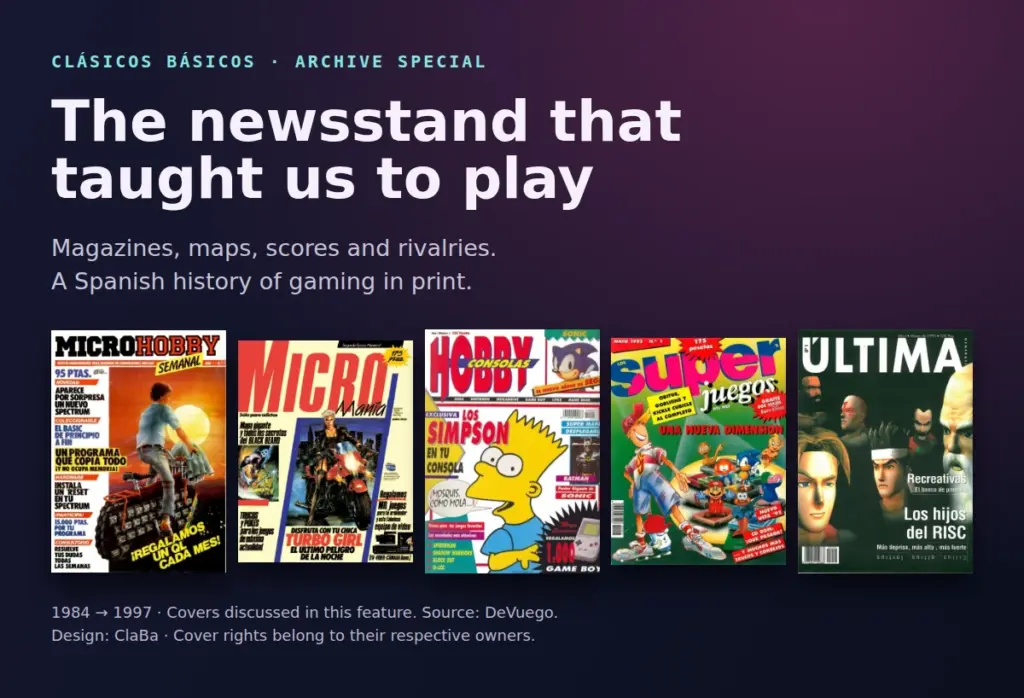
In this article 12 apartados +
- The magazine beside the keyboard
- A window that sometimes would not fit on the table
- Hobby Consolas: gaming as a conversation
- More than Sega versus Nintendo, more than consoles
- The trailer came on a videotape
- Ads, previews, and reviews make different promises
- Did we give the home team better scores?
- Four things those numbers do not justify saying
- Magazine archives can also help us question nostalgia
- Five clues before you look at the percentage
- Which magazine did you keep beside your machine?
- Sources, images, and acknowledgments
Before we opened twenty tabs to decide what to buy, we opened a magazine. We folded it beside the keyboard, traced a map with a finger, and argued over a score as though our lives depended on it. Spanish newsstands in the eighties and nineties sold information, but also something harder to measure: a way of being a player.
MicroHobby, Micromanía, Hobby Consolas, Superjuegos, PC Manía, Nintendo Acción, TodoSega, Mega Sega, Última Generación… They were not interchangeable. Some taught programming, others turned a launch into an event, and others sought a more adult voice. This special explores that ecosystem through covers, examples, and an uncomfortable question: how much of our taste did we choose ourselves, and how much did we learn to see through their pages?
The question takes on renewed relevance with Yova Turnes’s study of the reception of Spanish video games between 1995 and 2026. We read it alongside surviving issues, magazine archives, and accounts from the people who worked on them. It is a starting point for the conversation, not a retrospective explanation of the entire press or a verdict on every editorial team.
A GUIDE TO THIS SPECIAL
- 80 / 90
- From microcomputers to PCs and consoles, with plenty of overlap.
- 10 covers
- Identified issues, reproduced and discussed.
- 4 infographics
- A timeline, the functions of a magazine, and two charts from the study.
- One question
- How did we learn to discover, evaluate, and remember games?
The magazine beside the keyboard
To understand that press, imagine a computer that did not come with all the answers built in. Playing, learning how to use it, and working out what to buy could all be part of the same afternoon. The magazine met those needs without the tidy division between computing and video games that we now take for granted.
The first issue of MicroHobby, dated November 5–11, 1984, is a small statement of intent. Alongside games and Spectrum news, it features BASIC, readers’ programs, and accessories. Looking at its cover and remembering the games is not enough: its readers were also invited to type, correct, and build. The World of Spectrum archive lets us trace that continuity issue by issue.
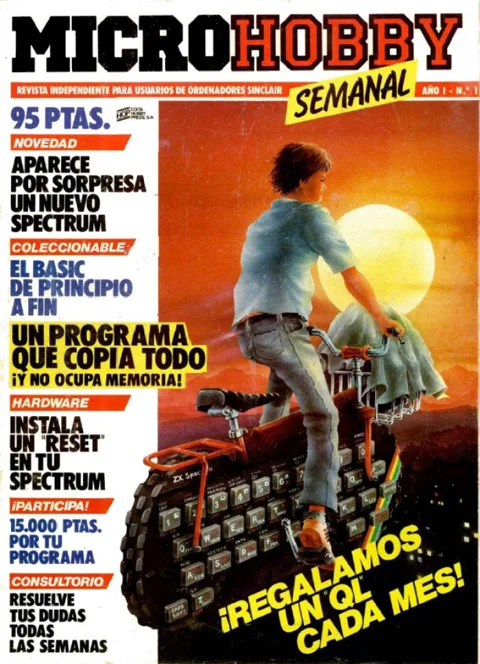
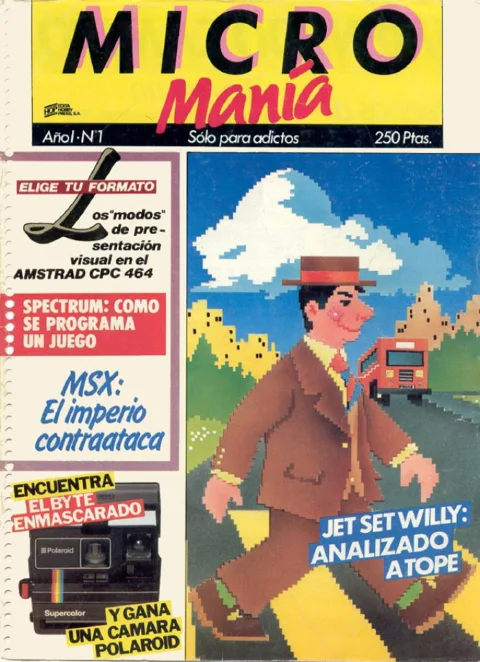
The MicroHobby cover promotes a program-copying utility; the first Micromanía puts Jet Set Willy front and center. An editorial difference is already visible: what each promises the buyer before the issue is even opened. In one, the machine and its possibilities; in the other, the experience of playing. These are not sealed compartments: that Micromanía’s contents page also makes room for technical material.
The landscape extended well beyond those two titles. The Museo de la Informática documents publications such as ZX, Input Sinclair, Amstrad Semanal, Amstrad User, Tu Micro Commodore and Amigos del MSX. Other titles included MSX Extra, MSX Club, Input MSX and Commodore World, listed in Francisco Charte Ojeda’s history of microcomputing. Your computer determined what your newsstand looked like.
That specialization had a cultural consequence. A magazine helped you feel that your computer was still alive: there were new releases, questions and answers, and people who knew things you had yet to learn. Today we can understand that bond as a community spread across the mail and the rhythm of print publication. It was not an early social network in every respect; there were filters, delays, and an editorial team deciding who got a place on the page.
A window that sometimes would not fit on the table
Some magazines are remembered for a writer’s byline, others for the physical object. Micromanía has both kinds of memory, but its second series added a particularly tangible one: unfolding a huge issue to enter a world of screens, illustrations, and maps. Its size was part of the experience.
The magazine began in 1985. The general publication record and the record for its first issue disagree on the exact month, so we retain the year here and always distinguish it from an issue’s cover date. In June 1988, issue 1 of the second series features Turbo Girl on the cover and promises a Black Beard map. In February 1995, issue 1 of the third series marks another restart in numbering. Three “issue 1s” do not mean three unrelated magazines.
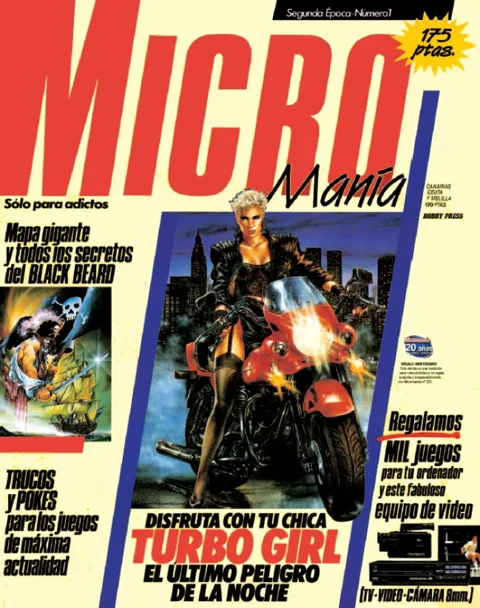
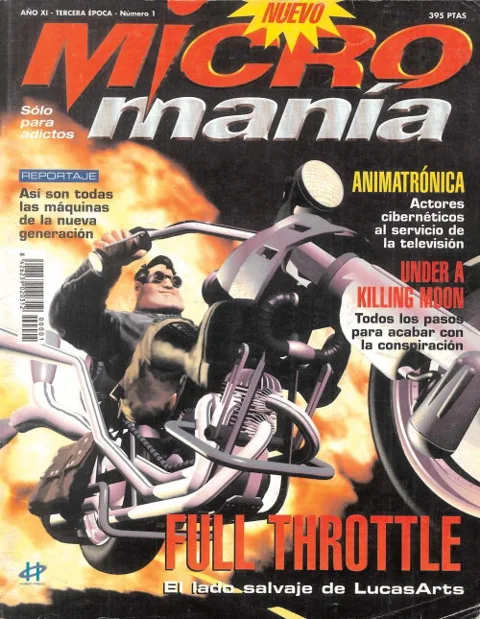
The Turbo Girl cover distills much of the period’s visual language: a prominent illustration, action, color, and the promise of mastering the game. Beside it, the 1995 issue belongs to a different landscape of machines and releases. Seeing them together reminds us that a publishing brand can change its format, its range, and its readership without changing its name.
The value of a printed map goes beyond nostalgia. It turned screens we knew separately into a space we could finally understand. A review told us whether a game deserved our time; a map let us inhabit it. Any history of these magazines that looks only at their final scores is therefore incomplete.
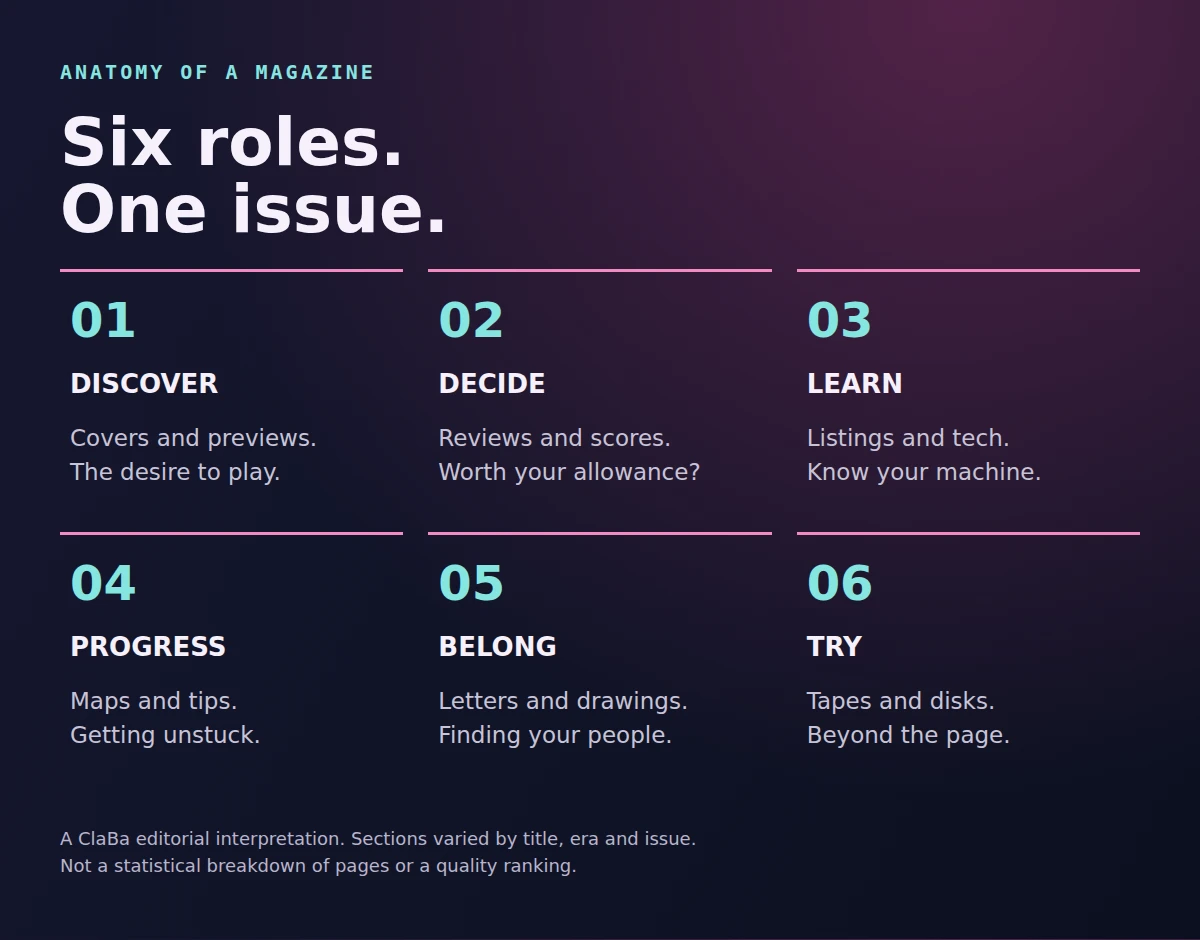
The six functions in the graphic are our editorial interpretation, not a page count: discovering games, deciding what to buy, learning technical skills, overcoming obstacles, participating, and, when an issue included physical media, trying something out. No magazine had to offer all six or give them equal weight. That is precisely where their differences began.
Hobby Consolas: gaming as a conversation
Readers of computer magazines did not disappear in the nineties: the audiences multiplied. Consoles offered a different relationship with the machine and a different way of presenting it. Newsstand magazines could address someone who wanted to play without wanting to learn programming.
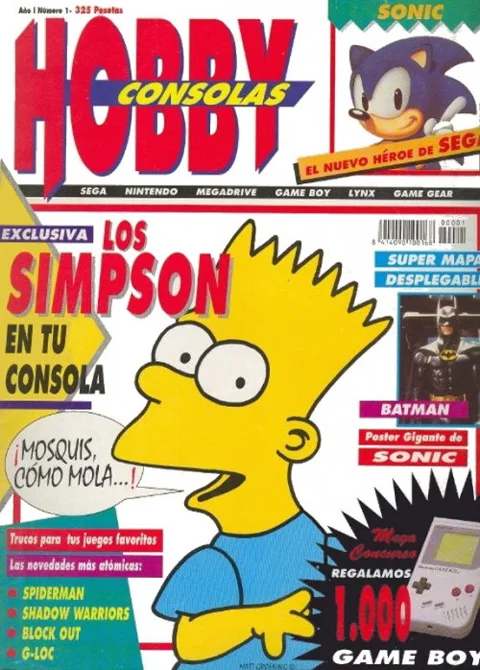
Hobby Consolas debuted with its October 1991 issue. In her thirtieth-anniversary retrospective, Sonia Herranz recalls its approachable language and its desire to connect with a young audience. A Bart Simpson cover needs no technical explanation to catch the eye: it connects a console, a popular character, and the desire to join that conversation.
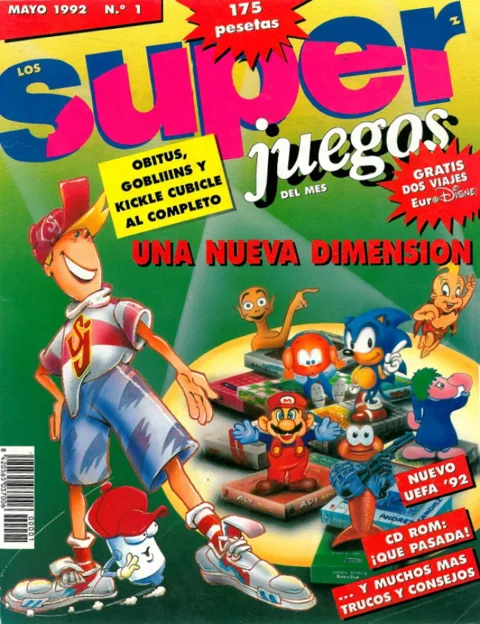
Superjuegos broadened the choice in 1992. Its first issue, dated May, includes console and computer reviews, maps, and a section on CD-ROM. That crossover matters: it would be a mistake to imagine that every magazine was born with the fixed identity we later assigned to it. A contents page can contradict our memories as readers.
Both covers work as shop windows, but they do not promise the same journey. Bart gives Hobby Consolas a recognizable face for its launch; Superjuegos presents its debut as entry into a new dimension. It is a small, verifiable observation. It is more useful than assigning a publication an entire personality based on what we remember from three issues.
And behind the jokes was a profession. In an interview with Nintenderos, Juan Carlos García says he went on to serve as managing editor of Hobby Consolas, Nintendo Acción, and TodoSega, combining content selection, editing, and playing. His account puts people and workloads where readers’ memories tend to put a brand. We are not talking about a mysterious voice: these were teams making decisions under deadline.
More than Sega versus Nintendo, more than consoles
Brand rivalries are easy to remember because they offer two sides and a punchy line. The real landscape was more tangled: general-interest magazines, platform-specific titles, PC readers, adaptations of foreign publications, and projects that tried to broaden the vocabulary of criticism.
Nintendo Acción launched with a December 1992 issue and Super Mario Kart as its draw. TodoSega covered the other side of the shop window. Mega Sega brought the British Mean Machines Sega model to Spain. Sharing a manufacturer on the cover does not mean sharing a publisher, style, or interests. And a magazine devoted to a brand is not automatically an official magazine: that status needs to be checked.
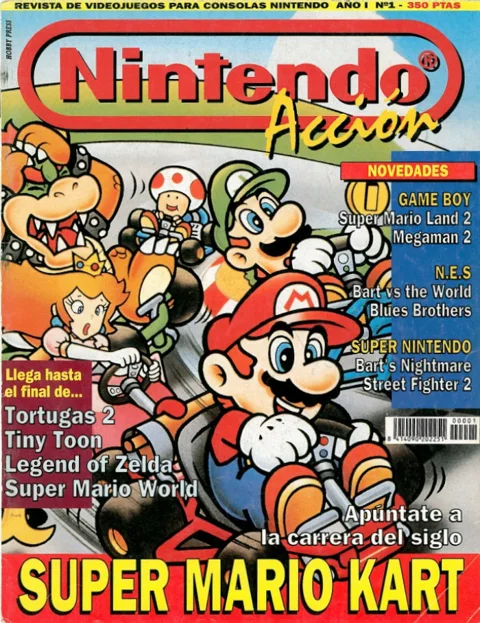
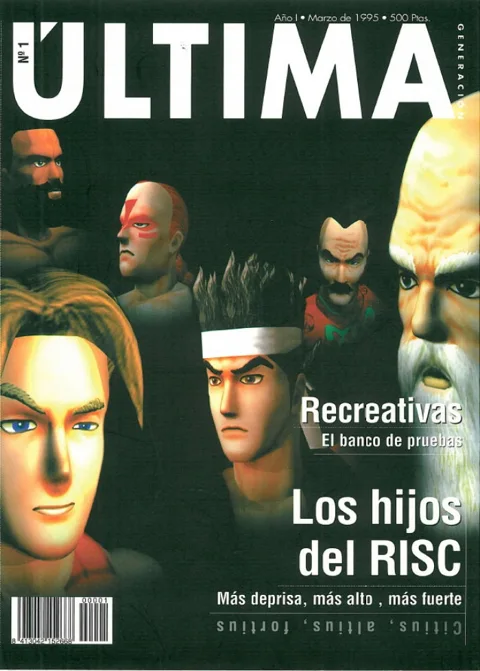
The first Nintendo Acción promises to help readers finish several games: a very practical relationship with someone who already owns a console. By contrast, Última Generación, in March 1995, makes RISC and new machines its cover story. Its run was brief: the publication record lists twelve issues. Yet its existence alone challenges the idea of a nineties gaming press that could do nothing but shout and assign percentages.
On PC, PC Manía and OK PC coexisted with the changing Micromanía. Later we find PC Player and the Spanish edition of Computer Gaming World. On consoles, PlayStation Magazine, PlayManía, PlanetStation, and Loading show that the end of the decade cannot be reduced to a single voice either. This is a guide to exploring the press, not an exhaustive census of everything that went to print.
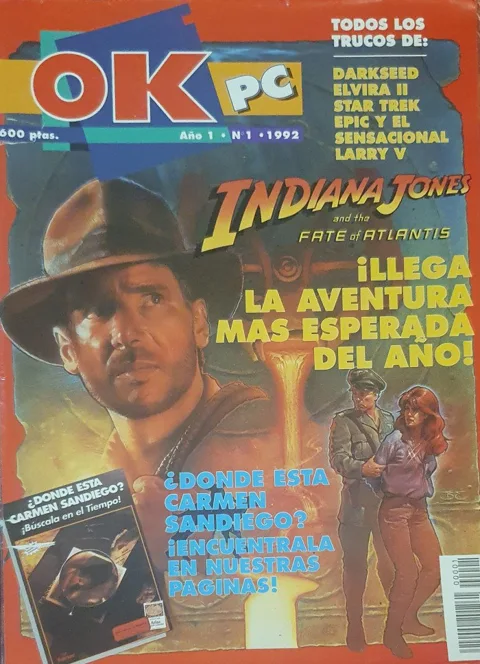
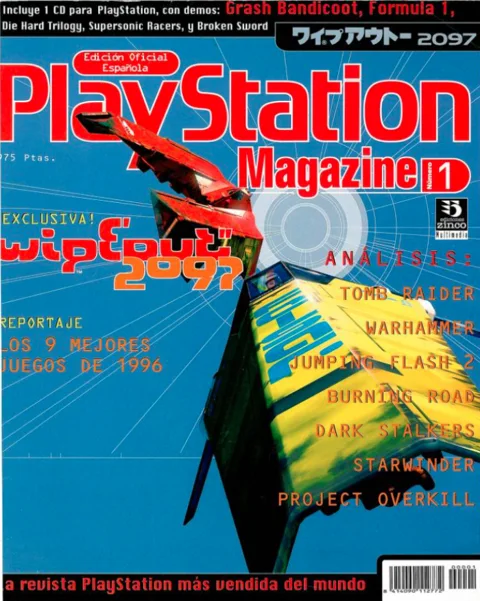
OK PC places the computer at the center of its cover’s promise; PlayStation Magazine presents a different identity built around a specific platform. These are two ways of selecting a world before reviewing a single game. Buying one or the other also meant choosing which releases you would hear about and which might pass unnoticed.
There is a particularly telling example in the PC Manía review archive: its reviews of PC Basket 2.0, Igor, and Commandos make the games’ Spanish origins visible. This is an observation about specific texts, not proof that their scores were unfair. It shows that cultural proximity could enter the critical conversation explicitly.
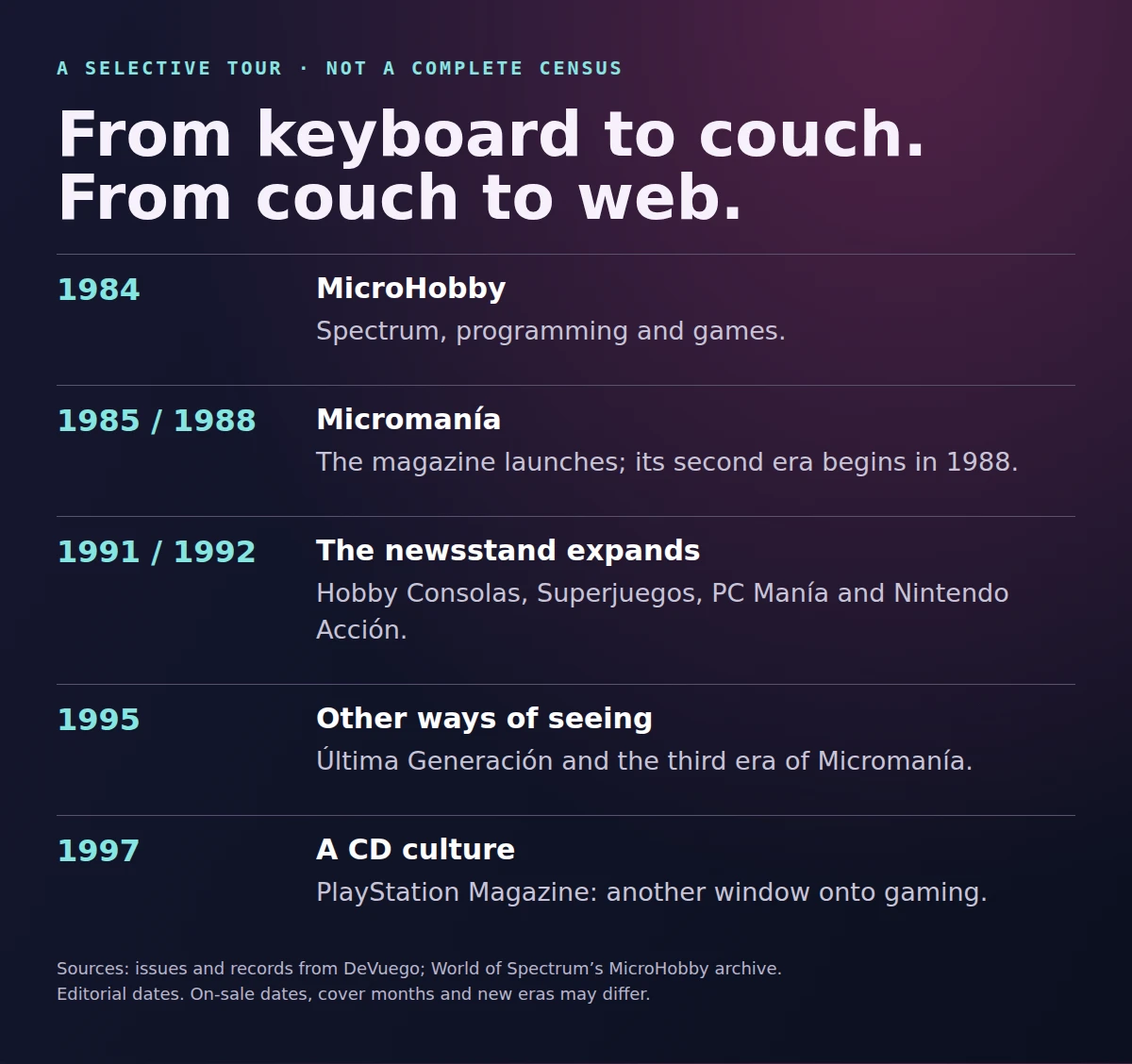
The trailer came on a videotape
For a reader without regular access to a game, a sequence of screenshots had a lot of work to do. It could explain a mechanic, show a new machine, or send expectations soaring. But paper could not show how it moved. Supplements changed that relationship.
In his look back at the VHS giveaways, Daniel Quesada explains how tapes let readers see releases and forthcoming consoles in motion, with substantial promotional involvement from Sega and Nintendo. They were not independent reviews simply because they came with a magazine. That is part of their historical interest too: they show what the industry wanted to present and how that material reached the living room.
Tapes, floppy disks, and CDs could add demos, utilities, or games to the reading package, depending on the publication and issue. The magazine became more than an explanation of something distant: sometimes it provided access to a small part of that world. To study an issue, it is worth preserving the whole package rather than keeping only the attractive cover.
Sales charts, readers’ votes, and editorial judgments should also be kept distinct. They all produce rankings, but they answer different questions. The bestselling game is not necessarily the editorial team’s favorite; the winner of a readers’ contest does not represent all of Spain. A figure looks precise even when we forget what it is counting.
Did we give the home team better scores?
Turnes’s study introduces a specific measure into a conversation usually settled through memories: how scores from Spanish and foreign outlets differ when they evaluate video games developed in Spain. The key is to compare the same games.
Published on Zenodo on September 24, 2026, Sesgo nacional en la recepción crítica del videojuego español: medios españoles frente a extranjeros (1995–2026) is a preprint; its publication there does not certify that it has undergone peer review. The author uses DeVuego, excludes reviews without numerical scores, and requires at least two Spanish and two foreign ratings per game for his main comparison. That leaves 443 games. He defines origin by the registered headquarters of the lead development studio and the outlet, not by the language each journalist writes in.
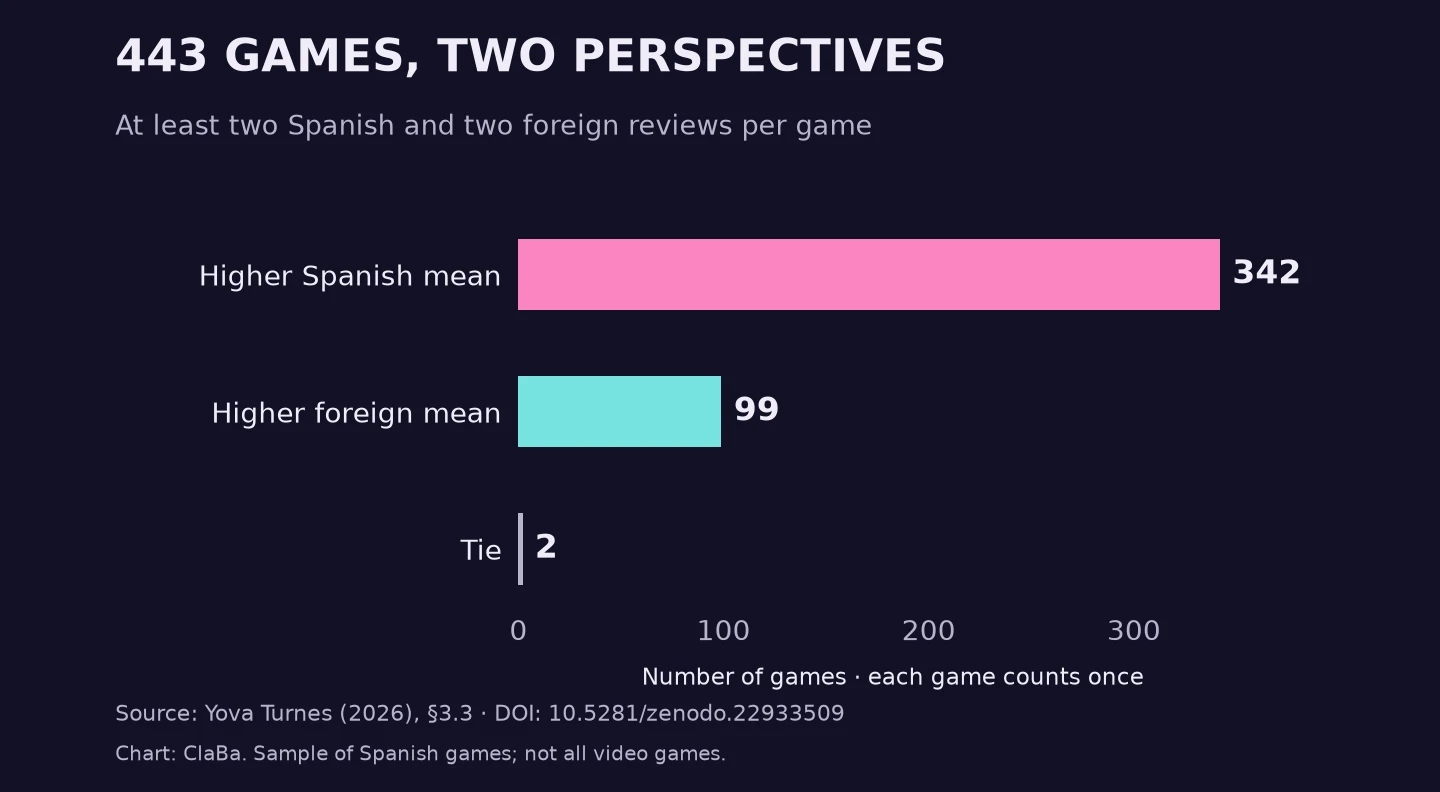
Within that sample, he reports a mean per-game difference of +6.14 points out of 100 in favor of the Spanish ratings. His count offers another way of seeing it: 342 games have a higher Spanish average, 99 have a higher foreign average, and two are tied. There is a pattern within the corpus, not a rule that holds for every title.
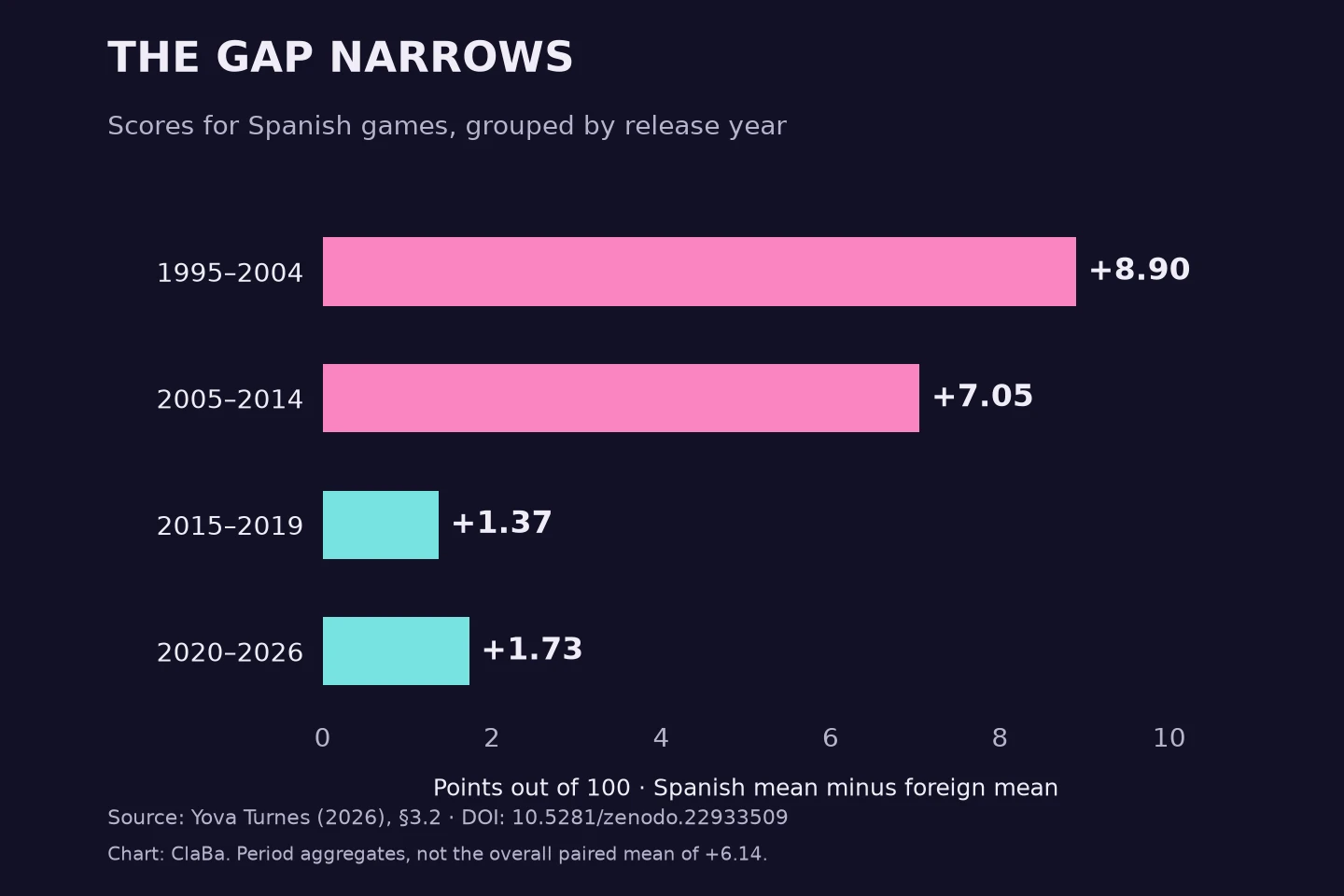
The study’s table by period is also interesting. It reports gaps of +8.90 points for 1995–2004; +7.05 for 2005–2014; +1.37 for 2015–2019; and +1.73 for 2020–2026. We have redrawn those values without extending the series back into the eighties. These are the period aggregates in section 3.2: they should not be confused with the mean of per-game differences in the main comparison.
| Game release year | Reported gap: Spanish − foreign / 100 |
|---|---|
| 1995–2004 | +8.90 |
| 2005–2014 | +7.05 |
| 2015–2019 | +1.37 |
| 2020–2026 | +1.73 |
The data in both charts also appear in these paragraphs and the table so that they can be read without relying on the images. These are the author’s results, not a new analysis of the original reviews carried out by ClaBa. The illustrations are ours.
Four things those numbers do not justify saying
- They do not describe the eighties. The study itself excludes the period before 1995 from its table by period because there are too few comparable games with foreign reviews.
- They do not prove payments or favors. A difference in scores does not, on its own, identify the cause: cultural familiarity, the selection of critics, or the use of rating scales may play a part.
- They do not fully isolate national favoritism. DeVuego is devoted to Spanish game development. Without an equivalent set of foreign games, the study cannot clearly separate preferential treatment of domestic work from greater generosity by Spanish outlets in general.
- They do not make a magazine and a website interchangeable. The breakdown names HobbyConsolas.com. That result cannot be used to assign a figure to the print magazine of 1991, all its writers, or every era of the brand.
There is another caveat: a surviving corpus is not the same as everything published. Which reviews have been located, which publications are included, and whether they assigned a score all determine what enters the comparison. Turnes also discloses that he is the founder and head of DeVuego, the data source. Transparency helps us evaluate the work; it does not replace the ability to reproduce it using the same material.
Our reading is that the study is more productive as a question than as a weapon. Do two outlets use a seven in the same way? Is one more willing to explain local cultural references? What happens to works that receive no foreign coverage at all? The observed difference deserves attention; explaining it requires more work.
Magazine archives can also help us question nostalgia
An old magazine preserves two histories at once: what was known then and what was not yet known. The second tends to disappear when we revisit it thirty years later, knowing the outcome of every launch by heart.
Today we know which consoles survived and which games became classics. A writer working toward a print deadline did not have that ending available. An enthusiastic preview that aged badly can therefore be a good historical source without being a good recommendation today. We need to ask what information the writer had, which version was being shown, and how much of the enthusiasm was supported by an argument.
There is no need to gloss over everything, either. Advertising, the language of belonging, and commercial expectations deserve a critical reading. We can examine who appeared as the default player, which pieces carried a byline, what counted as an important genre, or how many pages a small production received. These are questions to investigate through actual issues, not conclusions this special claims to prove without a count.
And preserve more than the cover. A contents page, an insert, or a letters page can tell a story the main headline conceals. Record the publication, issue, series, and pages; link to the issue’s record. Reissues, name changes, and restarted numbering make a reference such as “it was in Micromanía” fragile.
That newsstand helped us choose games, but also taught us how to talk about them: playability, difficulty, graphics, longevity, disappointment, surprise. Some of those words now feel too limited; others still work. The best way to repay those magazines is to read them with affection and attention. We can recognize what they gave us without asking them to have been infallible.
Which magazine did you keep beside your machine?
Tell us about a cover, a map, or a recommendation you still remember. If you can, add the issue number and year: a specific memory helps rebuild the archive.
Sources, images, and acknowledgments
Thanks to Yova Turnes, who has given us permission to cite and link to his research. Reference: Turnes, Y. (2026). Sesgo nacional en la recepción crítica del videojuego español: medios españoles frente a extranjeros (1995–2026), version 1.0, preprint. Zenodo. DOI: 10.5281/zenodo.22933509. The document is available under a CC BY 4.0 license. The charts in this special are new visualizations of results attributed to the author; the text and editorial interpretation are ClaBa’s.
- DeVuego PR_ES: records for the publications and the ten issues reproduced here. Each cover links to its record; for the eighties and nineties, we consulted contents pages as well as general publication records.
- World of Spectrum: MicroHobby: an issue archive used to trace the magazine’s chronology.
- Museo de la Informática: magazines and Historia de la microinformática: the diversity of publications and computer families.
- Sonia Herranz: Hobby Consolas’s thirtieth anniversary: the magazine’s own account of its language and beginnings.
- Interview with Juan Carlos García, Nintenderos: editorial work and moves between publications.
- Daniel Quesada: the VHS giveaways: the circulation of promotional footage alongside magazines.
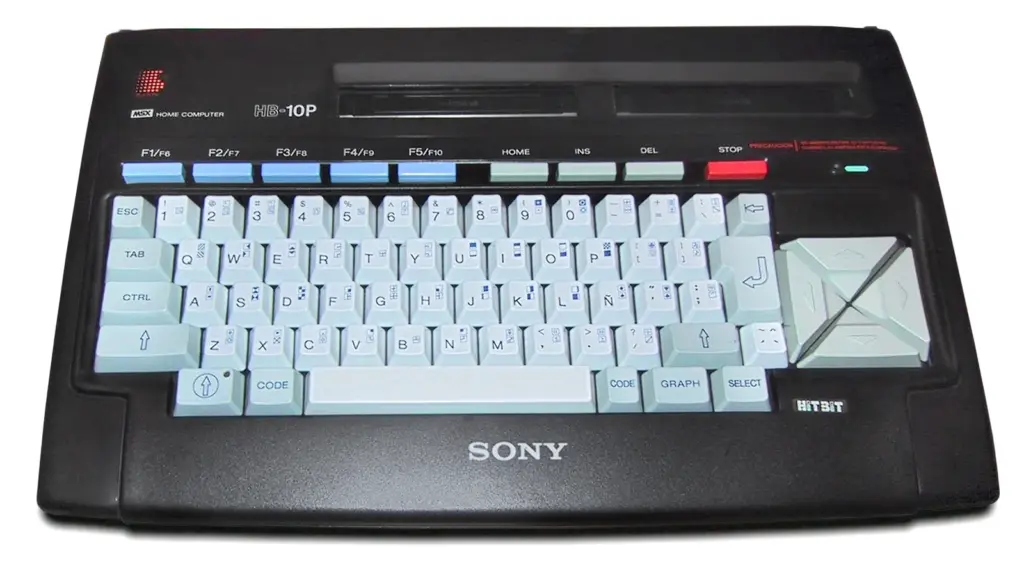
The covers are shown in full at reduced resolution as objects of historical commentary, with identification and a source beside each image. Their rights belong to their respective holders; the study’s license and its author’s permission do not extend to these magazines. No complete articles are reproduced, and this is not a collection of downloads. The MSX photograph retains its own credit. Sources consulted: October 22, 2026.
The best stories get shared.
Did it bring back a memory? The conversation continues on the forum (in Spanish).
Stay for one more game.
PCBIGBOXRETRO: a friend, lots of great games and boxes that won't fit in your house
PCBIGBOXRETRO is a friend of ours and we love it: classic PC games, Big Box collecting and three videos to start. After CLABA…
5 min read
Atari: from Pong to the landfill, the decade that invented home video gaming
From Pong to the Atari 2600 and from hit to the Alamogordo landfill: the story of the company that brought video games home…
9 min read
Amiga, Commodore and Hyperion: who owns what after the agreements
What Amiga Corporation signed with Commodore and Hyperion, who keeps the trademarks and copyrights, and what changes for 68K, OS4 and 8-bit users.
8 min read