
CULTURA / MEMORIA DIGITAL
Atari: from Pong to the landfill, the decade that invented home video gaming
From Pong to the Atari 2600 and from hit to the Alamogordo landfill: the story of the company that brought video games home and nearly sank them in 1983.
Read the story Share
In this article 18 apartados +
- A name taken from go and a Pong in a bar
- The Atari 2600: a console that raced the beam
- Atari VCS / 2600
- 1980: the year a shoot ‘em up sold consoles
- 1982: too many cartridges for too few homes
- 1983: the crash and the desert tomb
- 1984 onward: one brand, many homes
- From Pong to the wandering brand
- Atari is born
- Home Pong
- Warner buys Atari
- Atari VCS
- Space Invaders
- Pac-Man and E.T.
- Crash and landfill
- The split
- The excavation
- What Atari left us, and why we preserve it
Some companies make products and some companies make habits. Atari was one of the latter. Before it, a video game was something you played in a bar, with a coin in your hand. After it, it was something you plugged into the TV in the living room, swapped by sliding in a cartridge, and argued about in the schoolyard. All of that happened in little more than ten years, between 1972 and 1983, and it ended in the most unexpected way: with trucks full of cartridges heading for a landfill in the New Mexico desert.
This is the story of that decade, told without hurry but without filler: who founded Atari, why its console ran on just 128 bytes of memory, how a Japanese shoot ‘em up saved its sales, what happened with E.T. and why there are still Atari cartridges in museum display cases today.
Atari in five facts
- 1972
- Nolan Bushnell and Ted Dabney found Atari on June 27
- 128 bytes
- All the RAM in the Atari 2600
- 30 million
- 2600 consoles sold, approximately, over its entire commercial life
- 1983
- Year of the market collapse and the Alamogordo landfill
- 1984
- Warner sells the home division and Atari is split in two
A name taken from go and a Pong in a bar
Nolan Bushnell and Ted Dabney founded Atari on June 27, 1972. The name comes from go, the Japanese board game: it is the warning that a stone or a group of stones is about to be captured, something like check in chess. Quite a cocky statement of intent for a company that hadn’t sold anything yet.
The first thing it sold was Pong. Engineer Al Alcorn designed it, the prototype was tested in August 1972 at Andy Capp’s, a tavern in Sunnyvale, and the first commercial machines shipped in November of that year. By the end of 1974 Atari had already built more than 8,000 cabinets. The logical next step was to put Pong in the home, and in 1975 it did so with Home Pong, sold through the Sears department stores, which ordered 150,000 units for the Christmas season.
The problem was that a console with a single game runs out of steam quickly, and the idea that came next, a console with interchangeable games, cost far more money than Atari had. The solution arrived in November 1976: Warner Communications bought the company for $28 million and put up the capital to launch the machine that would change everything.
The Atari 2600: a console that raced the beam
The Atari VCS, which over the years everyone would call the 2600, came out in North America in September 1977. Its internal code name was Stella and it shipped with two joysticks, a pair of paddle controllers and one cartridge: Combat. The idea seems obvious today, but then it was a revolution: the console didn’t know how to play anything; the game came inside the cartridge, and each new cartridge turned the same machine into a different one.
Atari VCS / 2600
- Release
- September 1977 in North America; Europe, in 1978
- Code name
- Stella
- Processor
- MOS 6507 at 1.19 MHz
- RAM
- 128 bytes
- Video and sound
- TIA chip (Television Interface Adaptor), no screen memory
- Cartridges
- 2 KB for the first ones; 4 KB became the norm
- Pack-in game
- Combat
- Sales
- About 30 million consoles until production ended in 1992
The most fascinating thing about the 2600 is what it lacked. With 128 bytes of RAM, an image of the screen couldn’t fit in memory, so programmers had to draw it line by line as the television’s electron beam swept across, timing every instruction to the beam’s path. That technique is known as racing the beam, and it explains why the console’s games have such a distinctive look: every line of the picture was a small race against the clock. If you’re interested in the technical detail, the Atari 2600 entry lists the specifications and their sources.
1980: the year a shoot ‘em up sold consoles
The early years were no walk in the park. In 1977 about 400,000 consoles were built, and in 1978 550,000 of the 800,000 that left the factory were sold. Bushnell left the company in November of that year and command passed to Ray Kassar, an executive from the textile industry who ran the home division from 1978 and the entire company from 1979.
The decisive push came in March 1980 with the 2600 version of Space Invaders, the first big arcade-to-console adaptation. It was what we would now call a killer app: people bought the console to play it, and that year the number of 2600s in homes doubled to over two million.
That same 1980 saw the release of Adventure, by Warren Robinett, who hid his name in a secret room in the game because Atari didn’t put its programmers’ names on the boxes. It is the first Easter egg in a video game to become famous as such. And it is a symptom: in October 1979, four of the company’s programmers, David Crane, Bob Whitehead, Larry Kaplan and Alan Miller, had left to found Activision after being refused better pay, even though their games, according to the most-cited account, made up 60% of Atari’s cartridge sales in 1978.
1982: too many cartridges for too few homes
In 1982 Atari was a money-making machine. In the first nine months of the year it contributed half of the $2.9 billion in revenue Warner took in. And that euphoria led to manufacturing on a grand scale. The 2600 version of Pac-Man, released in March, sold more than seven million cartridges and was the console’s best-selling game; even so, it is usually said that Atari made more cartridges than there were consoles sold, and many ended up returned by players unhappy with the conversion.
The other big release of the year was E.T. the Extra-Terrestrial. Warner paid between $20 and $25 million for the license to Spielberg’s film, and to make the Christmas season programmer Howard Scott Warshaw had, according to the Smithsonian’s National Museum of American History, five and a half weeks instead of the usual six to nine months. The math was simple and cruel: to cover the cost of the license, about four million cartridges had to be sold. Slightly more than a million people bought it, and many returned it because they found it frustrating.
Dug up from a landfill, the object personifies the video game crash that took place between 1982 and 1985.
National Museum of American History (Smithsonian), on the E.T. cartridge in its collection. Our translation
1983: the crash and the desert tomb
The American video game market collapsed in 1983. There were too many consoles, too many games and too many bad games, and buyers stopped trusting what they were sold. Atari went from an operating profit of $100 million in the first quarter of 1982 to losing more than $500 million over the whole of 1983. Kassar resigned in July of that year.
In September, with the El Paso (Texas) plant in the process of closing, Atari sent several truckloads of cartridges and console material to the municipal landfill in Alamogordo, New Mexico, and covered part of the deposit with concrete. It was no secret: the local newspaper reported it, as did The New York Times, on September 28, 1983. But over the years those reports were forgotten and the dumping became an urban legend: millions of E.T. cartridges hidden in the desert by an embarrassed company.
In April 2014 an excavation with archaeologists, funded by a documentary production company, opened the trench and recovered a little over 1,300 games. They weren’t only E.T.: more than forty different titles came out, many still in their boxes and unsold. The case is documented in a public archaeological record, and Broken UFO has told the whole story, from the 1983 news report to the bulldozer: the complete story of Atari’s tomb in Alamogordo (in Spanish), with sources, figures and what the excavation disproved about the legend.

1984 onward: one brand, many homes
In July 1984 Warner got rid of the problem by splitting the company. The console and home computer division went to Jack Tramiel, the founder of Commodore, who renamed it Atari Corporation. The arcade side stayed on as Atari Games, which kept producing machines for years; in our catalog you can find Rampart, its 1990 strategy game.
Tramiel’s Atari launched the 7800 console, the ST computer, the Lynx handheld and, in 1993, the Jaguar, which failed to carve out a place against the Japanese consoles. After that, the brand passed through several hands: Hasbro Interactive bought the catalog in 1998, Infogrames bought Hasbro Interactive in 2001 and since 2003 it has published its games under the Atari name. The Fuji logo lived on; Bushnell’s company had long since ceased to exist.
From Pong to the wandering brand
- 1972
Atari is born
Bushnell and Dabney found it in June; Pong ships in November.
- 1975
Home Pong
Sears orders 150,000 units for Christmas.
- 1976
Warner buys Atari
$28 million to finance the VCS.
- 1977
Atari VCS
Released in September in North America with Combat.
- 1980
Space Invaders
The first big arcade conversion sends sales soaring.
- 1982
Pac-Man and E.T.
Record sales and the game that symbolizes the excess.
- 1983
Crash and landfill
Losses of over $500 million and trucks to Alamogordo.
- 1984
The split
Atari Corporation for Tramiel; Atari Games for the arcades.
- 2014
The excavation
A little over 1,300 buried games come to light.
What Atari left us, and why we preserve it
Almost everything we take for granted in a console was tried by Atari first: games on cartridges, independent studios publishing for someone else’s platform, arcade conversions as a draw, Easter eggs. It also left the industry’s most expensive lesson: a market flooded with bad games collapses, and when Nintendo arrived it did so with quality controls for third-party games.
And it left an image that is hard to forget: hundreds of thousands of games thrown into a trench because they were no longer worth anything, which thirty years later were auctioned off as relics. That’s why we at Clásicos Básicos insist so much on preservation. We explain it in Abandonware laid bare, about programs nobody sells anymore, and in When the box disappears, about what we lose when the physical format goes away. If you’re left wanting more classic computer history, the story of the Commodore Amiga is the natural sequel: Commodore, the company Tramiel himself founded, is the other half of this story.
The next time you see a black joystick with a single red button, remember that behind it stands a company that invented half an industry, lost almost all of it in a single year and ended up with part of its inventory under the desert. Few video game stories have so much of everything.
The best stories get shared.
Did it bring back a memory? The conversation continues on the forum (in Spanish).
Stay for one more game.
PCBIGBOXRETRO: a friend, lots of great games and boxes that won't fit in your house
PCBIGBOXRETRO is a friend of ours and we love it: classic PC games, Big Box collecting and three videos to start. After CLABA…
5 min read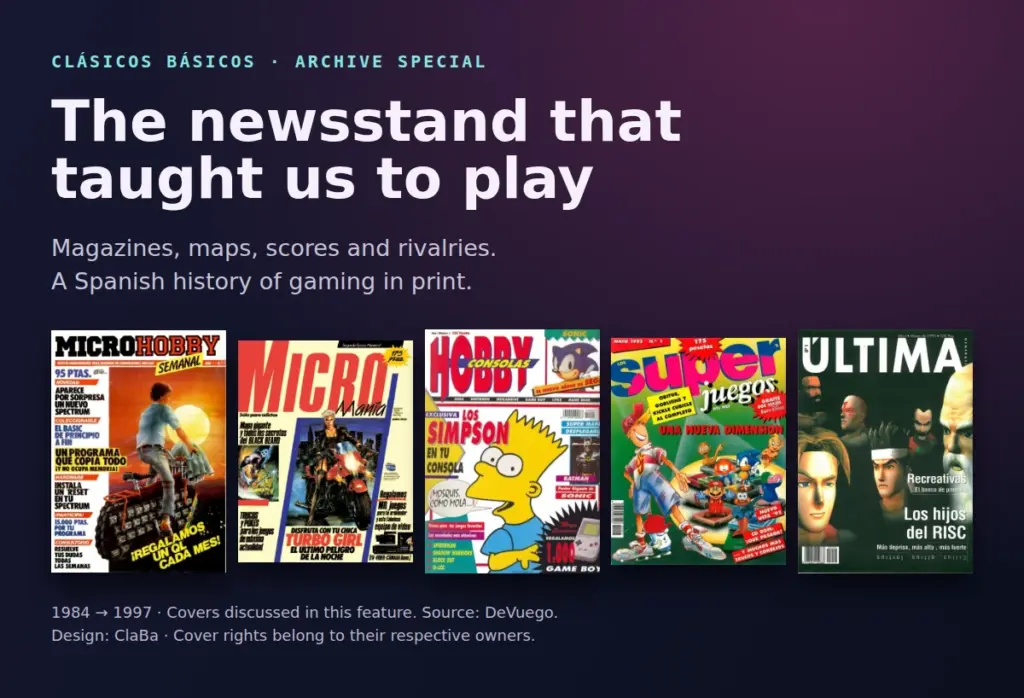
The Newsstand That Taught Us to Play: Video Game Magazines in Spain
MicroHobby, Micromanía, Hobby Consolas, Superjuegos, PC Manía: covers, infographics, and a critical look at the newsstands that shaped generations of gamers.
17 min read
Amiga, Commodore and Hyperion: who owns what after the agreements
What Amiga Corporation signed with Commodore and Hyperion, who keeps the trademarks and copyrights, and what changes for 68K, OS4 and 8-bit users.
8 min read